

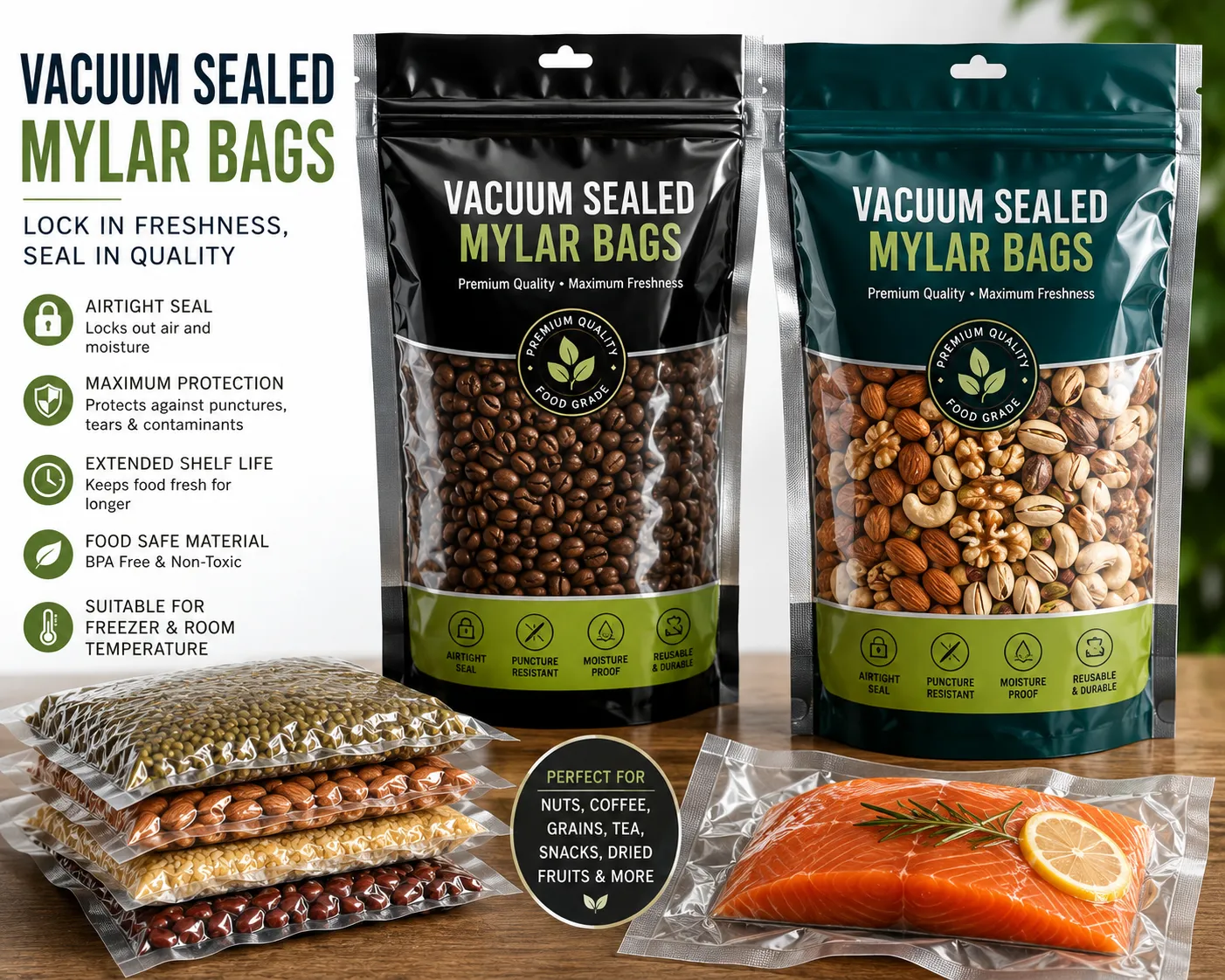
Packagly hears from home preppers and small food businesses who want one question answered clearly: how do you actually keep dry food edible for years instead of months? Vacuum sealed mylar bags answer that question when paired with the right oxygen absorber and a proper heat seal.
A pantry shelf full of loose bags of rice or oats invites moisture, light, and insects. None of those threats disappear on their own. Have you ever pulled a bag of flour from storage and found it clumped or smelling stale? That is oxygen and humidity doing their damage slowly.
This guide covers bag thickness, sealing methods, real shelf life numbers by food type, and the cost of building a long-term food storage system with mylar. You will also find a comparison table of bag gauges, answers to common storage questions, and guidance on choosing a supplier who understands food-grade barrier film.
Why long-term food storage relies on mylar
Mylar is a polyester film with a thin aluminum layer bonded to it, which makes it close to airtight once sealed. Food preservation research summarized by university extension programs puts mylar's oxygen transmission rate at roughly a hundred times lower than standard plastic packaging, and the aluminized layer blocks nearly all visible light. That combination stops the two biggest causes of spoilage in dry staples: oxidation and light exposure.
Vacuum sealed mylar bags work best on foods with very little residual moisture. Rice, wheat, dried beans, pasta, flour, and freeze-dried meals all suit this method well. Wet or oily foods, brown rice included, break the seal of protection faster because trapped fat and moisture speed up rancidity even inside a sealed bag.
Paired with an oxygen absorber, sealed mylar creates an environment where insects cannot survive and mold has nothing to feed on. Dry staples like white rice and wheat berries can hold their quality for two to three decades in these conditions, based on shelf life data cited by the USDA and several university extension programs. That single fact explains why so many households and small food producers have shifted to this method over standard pantry storage.
Choosing the right mylar bag thickness
Bag gauge, measured in mils, determines how much punishment a bag can take before it tears or punctures. A thinner bag works fine for short-term retail packaging, but long-term food storage calls for a heavier gauge that can survive years of stacking and handling.
|
Gauge |
Avg. Cost per Bag |
Best For |
Barrier Strength |
|
2.5 mil |
$0.15–$0.30 |
Sample sachets, short shelf life |
Light-duty |
|
3.5 mil |
$0.25–$0.45 |
Retail coffee, snacks |
Moderate |
|
5.0 mil |
$0.40–$0.70 |
Long-term bulk food storage |
High |
|
7.0 mil |
$0.60–$1.00 |
Heavy grains, bucket liners |
Very high |
How proper sealing and oxygen removal works
Filling the bag correctly comes first. Fill it, tap the bag on a hard surface to settle the contents, and leave enough headspace at the top for a clean heat seal. Skipping the tap-and-settle step often leaves air pockets that trap extra oxygen.
Oxygen absorbers come next, sized in cubic centimeters based on bag volume. A one-gallon bag of grain typically needs 300 to 500 cc, while a five-gallon bucket liner needs closer to 2,000 to 2,500 cc. Undersizing the absorber leaves residual oxygen behind, which shortens shelf life more than most people expect.
Heat sealing closes the loop. A flat iron or an impulse sealer works, though an impulse sealer gives a cleaner, more even seal across the width of the bag. Check the bag within 24 hours; a properly sealed bag pulls tight around the food, while a puffy bag signals a leak that needs resealing.
"A bag that still looks puffy the next morning has a seal problem, not an absorber problem," said a food storage specialist based in Alberta. "Reseal it before you assume the absorber failed."
What affects the cost of long-term food storage setups
Bag gauge and size drive most of the cost difference. A thicker, larger bag costs more per unit but holds up better against punctures during years of storage. Oxygen absorber size adds a smaller but real cost, since larger cc ratings cost more per packet than smaller ones.
Some storage guides put the added cost of a mylar bag and matching oxygen absorber at roughly one to two dollars per five-gallon bucket, which turns a sack of bulk rice into a food reserve that lasts decades instead of a year or two. Custom printing adds cost on top of that if a brand wants its logo or labeling on the bag itself, though plain bags with printed labels applied afterward keep costs lower for smaller operations.
Buying bags and absorbers in matched bundles usually costs less than sourcing them separately. A supplier who sells 50-bag and 50-absorber kits removes the guesswork of sizing and cuts down on wasted material from mismatched quantities.
Choosing a supplier for food-grade mylar bags
Food contact packaging sold in the United States must meet FDA food-grade material requirements, and mylar bags used for food storage should carry that certification on the product listing or spec sheet. A supplier who cannot point to food-grade documentation is not one to trust with pantry staples meant to last for years.
A packaging partner who works specifically with dry food storage, rather than general plastic film, will already know which gauge suits grain versus dehydrated produce and which absorber sizes match common bag volumes. Local companies like Packagly focus on food-grade mylar and custom pouch printing for small food producers, which means they carry the thicker gauges and absorber pairings that general packaging shops often skip.
That focus shows up in the details. A general supplier might stock only one bag thickness, while a specialist keeps several gauges on hand along with resealable zipper options for households that need to open and reclose bags between uses.
Frequently Asked Questions
What size oxygen absorber do I need for vacuum sealed mylar bags?
A one-gallon bag of grain or beans typically needs 300 to 500 cc, while a five-gallon bucket liner needs 2,000 to 2,500 cc. Going slightly larger than needed causes no harm, but an undersized absorber leaves residual oxygen behind.
How long does food really last in vacuum sealed mylar bags?
Dry staples like white rice, wheat, and dried beans can last 20 to 30 years when sealed properly with an oxygen absorber and stored below 70°F. Moisture content and storage temperature both affect the actual result.
Are vacuum sealed mylar bags food safe?
Yes, food-grade mylar bags meet FDA material requirements for direct food contact. Always confirm the specific bag you buy carries food-grade certification, since not every mylar product sold online meets that standard.
How much do vacuum sealed mylar bags cost?
Pricing depends on gauge and size, running from about $0.15 per bag for thin retail pouches to $1.00 or more for heavy 7 mil bucket liners. Oxygen absorbers add a small additional cost per bag.
What is the best mylar bag thickness for long-term food storage?
Most long-term storage guides recommend 5 mil or thicker for bulk grains and dry staples meant to last a decade or more. Thinner bags suit short-term retail packaging rather than years-long storage.
Can I reuse mylar bags after opening them?
Reuse is possible if the bag has a resealable zipper and no punctures, though the original oxygen absorber loses effectiveness once exposed to air. A fresh absorber is needed each time the bag is resealed for long-term storage.
Do vacuum sealed mylar bags need any special permits?
Selling packaged food in mylar bags may require compliance with local food labeling and food-grade material rules, which vary by state, province, or country. Check with a local health authority before selling sealed food products commercially.
How do mylar bags perform in hot or humid climates?
Heat speeds up spoilage even inside a sealed bag, and shelf life roughly halves for every 10°F rise above 70°F. Humid climates make a secondary container, like a food-grade bucket, more important to block moisture and pests.
Where can I buy vacuum sealed mylar bags in bulk?
Specialty packaging suppliers and preparedness retailers both sell mylar bags in bulk, often bundled with matching oxygen absorbers. Local suppliers can offer faster shipping and easier support for sizing and custom printing questions.
What foods should not go in mylar bags with oxygen absorbers?
Granulated sugar should never be sealed with an oxygen absorber, since the absorber also pulls moisture and can harden sugar into a solid block. Salt does not need an absorber at all and stores fine in any airtight container.
How do I know if my mylar bag sealed properly?
A properly sealed bag pulls tight and compresses around the food within 24 hours of adding the oxygen absorber. A bag that still looks puffy the next day has a seal leak and needs to be reopened and resealed.
What is the difference between mylar bags and standard vacuum sealer bags?
Standard vacuum sealer bags use a pump to remove air but offer little light or oxygen barrier once opened. Mylar bags combine an aluminized barrier with an oxygen absorber, giving a far longer shelf life for dry staples.
Building a storage system that actually lasts
Getting long-term food storage right comes down to matching bag gauge, absorber size, and sealing method to the food you are storing. A properly sealed bag checked within 24 hours catches most problems before they cost you a batch of grain or beans. If you want food-grade mylar bags sized correctly for your storage goals, reach out to Packagly for guidance on gauge, absorber pairing, and bulk pricing for your setup