

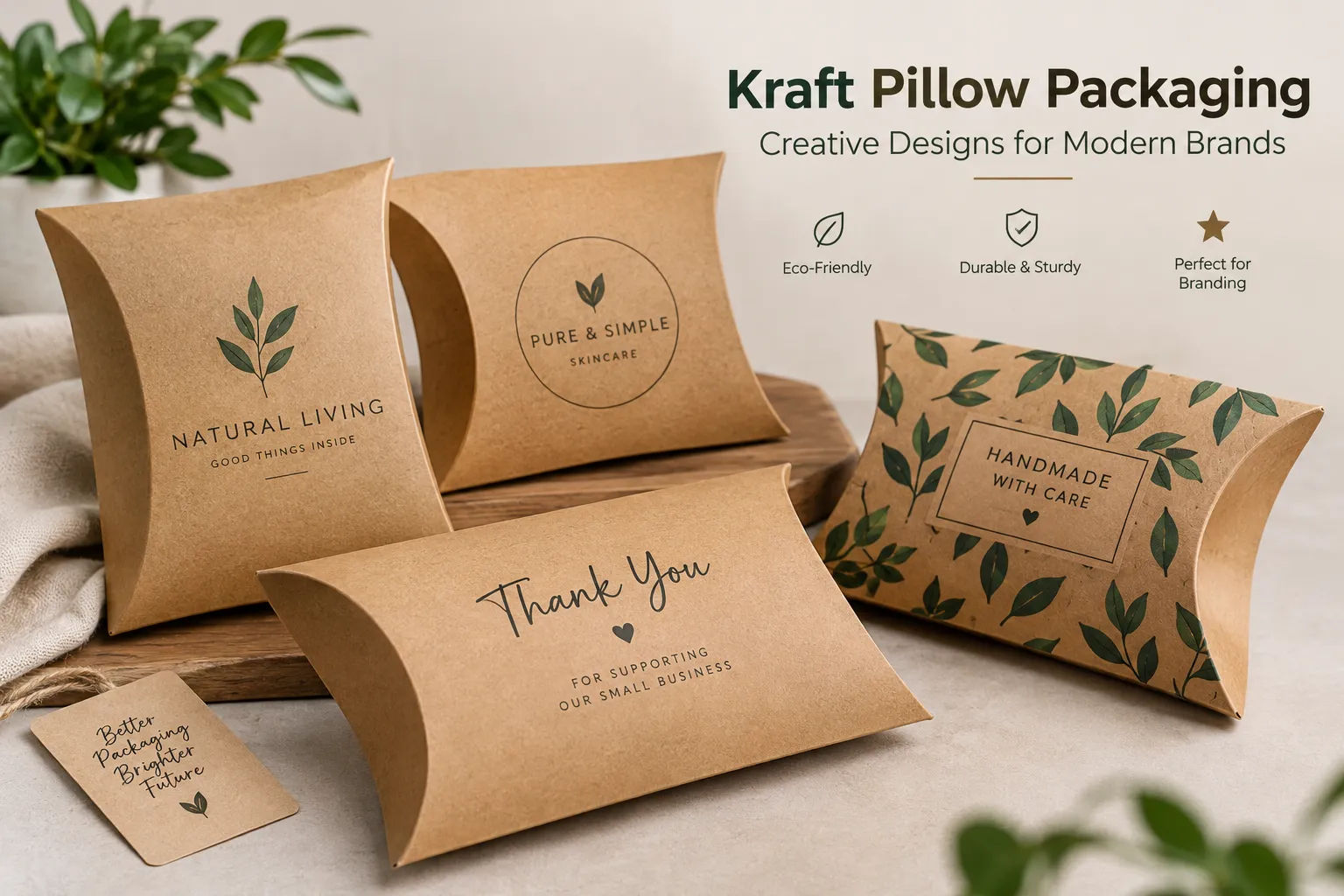
Shoppers pass dozens of products in a single store aisle. What makes a small box stop their hand? At Packagly, we see brands win that moment with kraft pillow packaging that looks honest, earthy, and carefully finished. On a crowded shelf, color, texture, and layout do the selling.
Pillow boxes have a curved, gift-like shape that feels friendly in the hand. They suit soaps, candles, tea, jewelry, candy, and small cosmetics. The shape folds flat for storage, ships light, and opens with one tug. Kraft board adds a natural look that many buyers link with care for the planet.
This guide covers the design styles that work, the steps from dieline to delivery, and the costs that shape your budget. You will leave with a clear plan for your own boxes. We share practical tips from real print runs. Ready to see what makes a pillow box sell?
Why brands choose eco-friendly pillow boxes
Walk into any farmers market and you will see the same brown paper box again and again. Buyers read it as natural, handmade, and low waste. That quick read is why kraft pillow boxes work so well for small-batch food, soap, and candle brands.
Kraft board gives you a forgiving canvas. Light scuffs from shipping blend into the fiber, and ink takes on a warm, matte tone. One dark ink can look rich on brown stock.
Brands can pick natural brown kraft, which keeps its raw color, or recycled kraft with visible flecks. Both suit this style, and both take water-based ink well.
The numbers back up the mood. According to the U.S. Environmental Protection Agency (2018 data), containers and packaging made up 82.2 million tons of U.S. municipal solid waste, or 28.1 percent of the total. Paper and paperboard packaging reached 41.9 million tons of that waste. Brands that pick recyclable board help shrink the pile.
Shoppers care about this too. A Nielsen global survey (2018) found that 73 percent of consumers would definitely or probably change their habits to reduce their environmental impact. Do you want your box to meet that expectation? Eco-friendly pillow boxes send the right signal before anyone reads a label.
Claims need care, though. In the United States, the Federal Trade Commission’s Green Guides (16 CFR Part 260) cover words like recyclable and compostable on packaging. Check your wording and your board type before you send artwork to print.
Design styles for custom pillow boxes
Four styles cover most small-brand needs, and each one changes how kraft pillow packaging reads on a shelf. The right pick depends on your product, your budget, and how much brown board you want to show.
Start with one-color print on bare kraft. A black or white logo with a short line of text looks clean and costs the least. Soap makers and tea brands lean on this style because the board does most of the talking.
White ink or a second color adds contrast. White prints as a bold layer on brown stock, so names and icons pop from several feet away. Printers sometimes run two passes to reach full opacity, which nudges the price up.
A window cutout lets the product sell itself. Candy, jewelry, and bath bombs look great through a small opening. Many brands use a thin film over the window, and that film affects recycling.
Foil, embossing, and spot UV give a premium finish. A small gold foil logo on a brown box feels like a gift. Use these touches sparingly, because they raise cost and can limit recycling.
Layout matters as much as finish. A packaging designer in Chicago says the curve of a pillow box hides text near the edges, so keep your main message on the flat center panel. Put the story, ingredients, and barcode on the back.
Take a soap maker in Chicago who sells at weekend markets. She switched from plain kraft boxes with stickers to one-color printed boxes with a small window. Shoppers could see the bar’s color and swirl without opening anything, and her cost per box stayed under a dollar.
|
Design style |
Est. cost per box |
Shelf impact |
Best for |
Eco note |
|
One-color print on bare kraft |
0.35–0.60 |
Natural, simple |
Soap, tea, candles |
Easy to recycle |
|
White ink or two-color print |
0.45–0.80 |
Bold contrast |
Candy, cosmetics |
Use water-based ink |
|
Window cutout |
0.50–0.90 |
Shows the product |
Treats, jewelry, bath bombs |
Remove film to recycle |
|
Foil or spot UV accents |
0.70–1.30 |
Premium feel |
Gifts, beauty items |
Coatings can limit recycling |
Costs above are estimates for runs near 1,000 boxes. Your quote will vary.
From dieline to delivery: how the process works
A good box starts long before any ink touches the board. Your supplier first builds a dieline, which is the flat template showing folds, glue tabs, and cut lines. Most pillow box projects follow the same six steps.
- Share your product size, weight, and quantity so the supplier can build the right dieline.
- Place your artwork on the dieline with outlined fonts and 300 dpi images.
- Approve a digital proof, and ask for a physical sample to check ink color on kraft.
- Print the sheets, using digital for short runs or offset for larger ones.
- Add finishes such as foil or emboss, then die cut, crease, and glue the boxes.
- Pack the boxes flat and ship them to your door.
Steps three and four decide most of your results. Brown stock shifts colors, so a bright blue on screen can print darker and duller. Keep key text about an eighth of an inch inside the fold lines, and extend background color past the cut line. A physical sample saves you from a costly reprint.
Cost factors that move your quote
Price comes from a handful of choices. Box size and board thickness set the base cost. Print colors, white ink, finishes, and window film add to it. Quantity matters most, because setup costs spread across more boxes as your run grows.
Most printed runs of kraft pillow boxes land between about $0.35 and $1.30 per box at 1,000 units. Smaller runs cost more per box. Ask each supplier whether shipping, proofs, and design help sit inside the quote.
How to choose the right packaging supplier
Price tells only part of the story. A low quote means little if the proof arrives with muddy colors or the boxes crush in transit. Ask any supplier to show finished kraft pillow packaging in your size, not just digital renders.
Specialists often have an edge here. A supplier that focuses on custom boxes, like Packagly in Chicago, handles dielines and kraft color shifts every week. That means low minimums, help from in-house designers, and finishes such as matte lamination, spot UV, embossing, and foil are part of the normal workflow. A general print shop may treat a pillow box as a one-off job. That can mean slower proofs and less advice on board and ink.
Use this short checklist when you compare wholesale pillow boxes with free shipping across the USA:
- Can I see a physical sample on real kraft board?
- What board thickness do you use, and does it suit my product weight?
- What is the minimum order, and what does each extra 500 boxes cost?
- How long do proofs and production take?
- Does the quote include shipping and design help?
Food brands need one more check. In the United States, paper that touches food falls under FDA rules in 21 CFR Part 176. Raw kraft does not suit greasy or wet food, so use a liner or bag inside the box and ask for food-contact paperwork.
Read reviews and past work, and send a small test order if you can. Do you really want to learn about color problems on a 5,000-box run? A sample order answers that question for a few dollars.
Frequently asked questions
What is kraft pillow packaging used for?
Kraft pillow packaging holds small, light items such as soap bars, tea, candles, jewelry, candy, and small cosmetics. The curved shape suits gifts and retail shelves. Natural brown board gives food and wellness brands an earthy look that buyers link with care for the planet.
How much do printed pillow boxes cost?
Most printed runs of about 1,000 boxes fall between $0.35 and $1.30 per box. Size, print colors, finishes, and window film change the price. Larger runs lower the cost per box because setup costs spread across more units. Compare quotes that use the same specs.
What is the minimum order for custom pillow boxes in Chicago?
It varies by supplier. Many digital print shops accept a few hundred boxes, and some accept fewer. Chicago-based suppliers like Packagly list low minimums for growing brands, so you can test a design before a large run. Ask for a written quote.
Do pillow boxes need a permit or approval in the USA?
A box needs no permit by itself. Rules apply to what you print and what the box touches. In the USA, the FTC Green Guides cover recyclable claims, and FDA rules apply to paper that touches food. Rules in the UK, Canada, and Australia differ, so check local guidance.
Can pillow boxes hold food safely?
Yes, with care. Raw kraft board does not suit greasy or wet food on its own. Use a food-safe liner, bag, or wrapper inside the box, and ask your supplier for food-contact documentation that meets FDA rules.
How do kraft boxes hold up in Chicago’s humid summers and cold winters?
Kraft board absorbs moisture, so damp air can soften it. A water-based aqueous coating adds light protection. Store boxes flat in a dry room and keep cartons off the floor. Cold air alone does not harm the board.
Can I print white ink on kraft?
Yes. White ink prints as a solid layer on brown board, and it looks bold. Printers often run two passes to reach full opacity, which can raise the price slightly. Ask for a physical sample to check the final shade before you approve a run.
Is free shipping available for wholesale pillow boxes in the USA?
Many suppliers include free shipping across the USA when you order in bulk. Ask whether your quote covers freight, proofs, and design help. Compare the total cost, not just the price per box, so you can judge each offer fairly.
How long does custom pillow box production take?
Most suppliers quote 6 to 8 working days after proof approval for standard runs. Complex finishes such as foil or embossing take longer. Proof changes add days, so send final artwork on the correct dieline the first time.
Can printed pillow boxes go in the recycling bin?
Plain kraft board with water-based ink usually can. Plastic window film, heavy lamination, and foil may need removal or can limit recycling. Local rules differ by city, so check your area’s guidelines and label the box clearly