

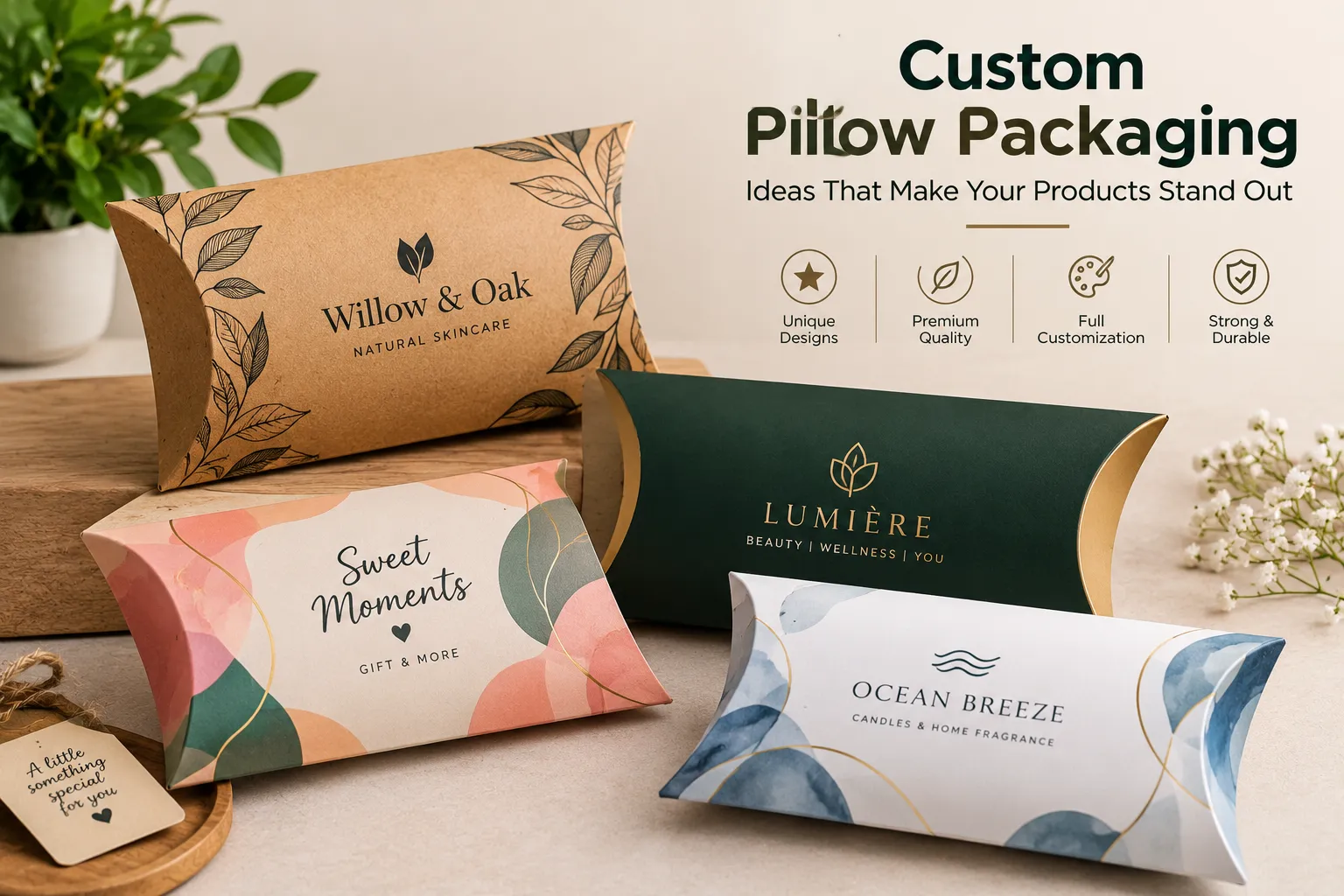
A box in a shopper’s hands sets the tone before they see the product. How does a small brand make that moment feel special? At Packagly, we see custom pillow packaging do it again and again, with a curved shape that feels like a gift and a finish that feels cared for.
Pillow boxes suit soaps, candles, jewelry, tea, candy, and small beauty items. They fold flat for storage and open with a gentle pull. Add a ribbon, a tissue wrap, or a thank-you card, and a simple box becomes a small event. Buyers keep a good box, reuse it, and often photograph it.
This guide shows how shape, board, finishes, and inserts shape the first impression. We cover the production steps, the cost factors, and what to ask a supplier. You will finish with a clear plan for your own boxes. Ready to build one worth keeping?
Why branded packaging starts with the shape
Open any gift shop drawer and you will find the same few box shapes. The pillow box stands out because its curved sides look soft and hand-finished. That softness signals care, which is the feeling a premium brand wants to create.
Shoppers notice the difference. The Macfarlane Packaging UK Unboxing Survey (2022), which covered more than 1,000 consumers, found that 52 percent are likely to buy again when a delivery arrives in premium packaging. The same survey found that 61 percent get more excited about a parcel when the packaging carries a brand.
Sustainability matters here too. The survey showed that 27 percent of consumers will not buy from a retailer whose packaging is not sustainable. Do you want to lose more than one in four shoppers over a box? Paper-based, eco-friendly packaging answers that worry.
Local rules shape what you can print. In the United States, the Federal Trade Commission’s Green Guides (16 CFR Part 260) cover words like recyclable on packaging. Buyers in the UK, Canada, and Australia follow similar consumer protection rules, so keep every green claim factual.
Cost and storage seal the deal for small teams. A flat-packed pillow box takes little shelf space and ships light. You can order a few hundred, test the response, and reorder once the design proves itself.
Board, finishes, and inserts for gift packaging
Good design starts with the board in your hand. Custom pillow packaging often uses 16 to 24 point paperboard or kraft stock, because thinner sheets can crush at the curve. Heavier board also feels more solid when a customer lifts it.
Premium feel comes from touch. Soft touch lamination gives a velvet surface, and embossing raises a logo you can feel. Foil adds a mirror shine to a name or border, and spot UV makes one shape glossy against a matte field.
Inserts finish the story. A tissue wrap, a thank-you card, or a ribbon costs little and photographs well. Many brands print a short message on the inside panel, so the reveal feels personal.
A packaging designer in Chicago puts it simply: the opening moment decides whether a buyer feels the product is worth its price. Her advice is to spend on one touch, such as foil or soft touch, and keep the rest clean.
Take a candle maker in Chicago who ships gift sets for the holidays. She chose a matte black box with a small foil logo, a tissue wrap, and a printed thank-you card. The box cost under a dollar at 1,000 units, yet the set looked like a boutique gift.
|
Option |
Est. cost per box |
Look and feel |
Best for |
Eco note |
|
Matte kraft, one-color print |
0.35–0.60 |
Natural, honest |
Soap, tea |
Easy to recycle |
|
Soft touch matte white or black |
0.60–1.00 |
Velvet, modern |
Beauty, candles |
Lamination limits recycling |
|
Foil and emboss on paperboard |
0.80–1.40 |
Polished, gift-ready |
Jewelry, gift sets |
Foil limits recycling |
|
Window with ribbon insert |
0.70–1.20 |
Open, playful |
Candy, accessories |
Remove film to recycle |
Costs above are estimates for runs near 1,000 boxes. Your quote will vary.
How a box goes from sketch to doorstep
Every box begins as a flat template, or dieline, that shows the folds, glue tabs, and cut lines. Your supplier builds it from your product size and weight. Six steps follow.
- Send your product size, weight, and target quantity to get a dieline.
- Add artwork with outlined fonts, 300 dpi images, and key text inside the safe zone.
- Approve a digital proof and request a printed sample.
- Print the sheets, using digital printing for short runs and offset for larger runs.
- Apply finishes such as foil or soft touch, then die cut, crease, and glue.
- Pack the boxes flat and ship them to your address.
Keep your logo on the flat center panel. The curve bends anything near the edge, so text there can look warped. Order a physical sample before a large run, because screens rarely match printed color.
What changes the price per box
Size and board weight set the base price. Colors, finishes, and window film add to it. Quantity has the biggest effect, because setup costs spread across more boxes.
Most printed runs of pillow boxes at 1,000 units land between about $0.35 and $1.40 per box. Short runs cost more per box. Ask whether proofs, design help, and shipping sit inside the quote.
How to choose the right box supplier
Quotes arrive in all shapes, so compare more than the price. Ask each supplier for finished custom pillow packaging in your size, plus a printed sample on the board you plan to use.
Specialists often have an edge. A supplier that focuses on custom boxes, like Packagly in Chicago, handles dielines, color shifts, and finishes every week. That shows up as low minimums, help from in-house designers, and options such as gloss or matte lamination, spot UV, embossing, and foil. A general print shop may treat a pillow box as a one-off job, which can mean slower proofs and thinner advice.
Use this checklist when you compare custom pillow boxes in Chicago or wholesale pillow boxes with free shipping across the USA:
- Can I see a printed sample on the exact board?
- What is the minimum order, and how does the price drop at higher counts?
- How long do proofs and production take?
- Does the quote include design help and shipping?
- Which finishes can I recycle or remove?
Food gift sets need one more check. In the United States, paper that touches food falls under FDA rules in 21 CFR Part 176. Raw paperboard does not suit greasy food, so use a liner or bag inside the box and ask for food-contact paperwork.
Start with a small order if you can. Why risk a full run on an untested color? A sample batch tells you far more than a mock-up.
Frequently asked questions
What is custom pillow packaging?
Custom pillow packaging means gift-style boxes with curved sides that fold flat and tuck closed. You choose the size, board, print, and finish. Brands use it for soap, candles, jewelry, tea, and small beauty items because the shape feels like a present.
How much do custom pillow boxes cost?
Most printed runs of about 1,000 boxes cost between $0.35 and $1.40 per box. Finishes such as foil, embossing, and soft touch push the price toward the top. Shorter runs cost more per box, so compare quotes with the same size, board, and print.
What is the minimum order for pillow boxes in Chicago?
It varies. Many printers accept a few hundred boxes, and some accept fewer. Ask Chicago suppliers for a written quote that lists the minimum, the proof cost, and the lead time. A small first run lets you test the design before you scale.
Do pillow boxes need a permit or label approval in the USA?
A box needs no permit by itself. Rules apply to what you print and what the box touches. In the USA, the FTC Green Guides cover recyclable claims, and FDA rules apply to paper that touches food. The UK, Canada, and Australia have their own rules, so check local guidance.
How long does production take?
Many suppliers quote 6 to 8 working days after proof approval for standard runs. Foil and embossing take longer. Proof changes add days, so send final artwork on the correct dieline the first time.
Is free shipping available for wholesale pillow boxes in the USA?
Many suppliers include free shipping across the USA when you order in bulk. Ask whether your quote covers freight, proofs, and design help. Compare the total cost, not just the price per box, so you can judge each offer fairly.
How do paperboard boxes hold up in Chicago’s humid summers and cold winters?
Paperboard absorbs moisture, so damp air can soften an uncoated box. An aqueous coating or lamination adds protection. Store boxes flat in a dry room and keep cartons off the floor. Cold air alone does not harm the board, but wet boxes after rain or snow can warp.
Can I add a ribbon or insert to a pillow box?
Yes. Ribbons, tissue wraps, thank-you cards, and small paper inserts all fit well. Tell your supplier about each item before the dieline is final, so the box closes cleanly and the product sits snugly inside.
Are pillow boxes eco-friendly?
They can be. Paperboard and kraft stock are recyclable in many areas, and water-based inks help. Lamination, foil, and plastic window film can limit recycling. Choose fewer coatings, label the box clearly, and check your city’s recycling rules.
How do I make an unboxing feel premium on a small budget?
Spend on one touch, such as foil or soft touch, and keep the rest simple. Add tissue and a thank-you card, which cost pennies. Print a short message inside the box. Clean design and a snug fit matter more than many effects.
Your next step is small and clear. Pick one finish, one insert, and one message for the front panel. Then reach out to Packagly for a free quote and ask about board options and low minimum orders for your product. Send your logo and product size, and the team can help you set up the dieline. You can start with a small order and grow from there. A little planning now gives you a box that customers keep, reuse, and remember