

Every week, makers ask Packagly the same question: will my ice cream packaging survive the freezer and still look great on the shelf? It is a fair worry. A tub that sweats, bends or peels can ruin a good flavour before anyone takes a bite.
Good packaging does three jobs at once. It protects the product from freezer burn and leaks, it carries your brand and allergen details, and it gives shoppers a reason to choose your tub over the next one. Small gelato shops, dairy startups and national brands all face the same decisions.
This guide covers the main pack types, the materials behind them, how custom printing works and what moves the price. You will finish with a clear checklist for choosing a supplier, whether you sell in the UK, the US, Canada or Australia. We keep the advice practical, so you can act on it today. Ready to start?
Why frozen dessert packaging matters more than most makers expect
Walk down any supermarket freezer aisle and the problem becomes obvious. Dozens of tubs compete for a few seconds of attention. A clear colour scheme, a bold flavour name and a tidy layout win that moment, and a plain white tub rarely does.
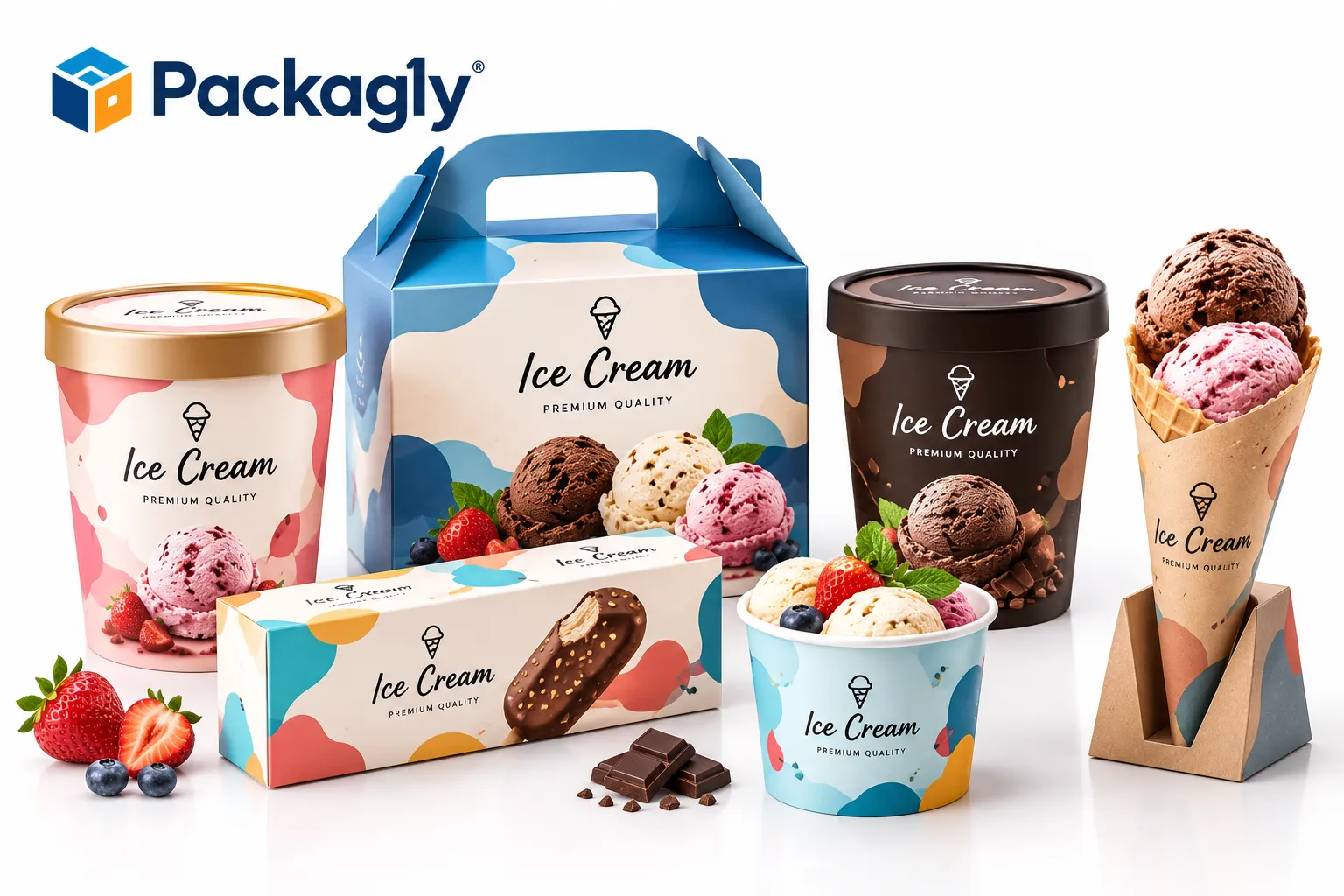
Ice cream packaging covers everything that holds, protects and sells the product. That includes pint tubs, paperboard cartons, cups, cone sleeves, lolly wrappers and outer shipping boxes. Cafés rely on takeaway cups with lids, and online sellers add insulated mailers.
Why do buyers pay so much attention to the pack? Shoppers link strong design with fresher, better-tasting food. A well-planned pack gives you room for flavour notes, allergen details and a short brand story.
Cold storage sets the rules. According to the USDA Food Safety and Inspection Service (2013), food held constantly at 0°F (-18°C) stays safe to eat, which is why most frozen desserts are stored at that temperature or colder. Your pack has to handle that cold day after day without cracking, sweating or peeling.
Types and materials for ice cream tubs, cups and cartons
Most makers start with the material, because it sets both the cost and the freezer performance. Coated paperboard is the usual choice for pint cartons and multipacks. A thin food-grade barrier on the inside stops moisture from soaking into the fibres, and the surface takes detailed print well.
Kraft board suits artisan brands that want a natural, earthy look. It needs a liner or coating to resist condensation, so ask how it behaves after a week in the freezer. Many brands now choose eco-friendly pint cartons of this kind, usually FSC-certified board with a water-based barrier.
Plastic still has a place. Polypropylene tubs are tough, stackable and reusable, which suits scoop shops and catering sizes. Clear PET cups show off layered sundaes and toppings, but check the freezer rating, because not every grade handles deep-freeze storage.
Shape and structure matter as much as material. Tuck-end cartons are quick to fill, and window cartons let shoppers see the product. Sleeves slide over inner tubs for a premium feel, and drawer-style packs suit ice cream sandwiches and single-serve bars. Custom printed ice cream tubs and cups work best when the design leaves clear space for the barcode and allergen panel.
Lids and seals deserve attention too. A snug lid or a tamper-evident label protects the product and reassures shoppers.
Delivery changes the brief. Online orders need an outer corrugated box with insulation and a coolant, and carriers set their own rules for dry ice, so ask about labelling before you ship.
Imagine a small-batch maker in Melbourne launching six flavours for summer markets. She chooses coated paperboard pint cartons with a matt finish and a small window. Condensation worries her most, so she asks for freezer-tested samples before approving the full run.
A food packaging technologist working with UK dairy brands says most freezer failures trace back to the wrong coating, not the wrong board. That matches what we see. Test a sample in a real freezer for 48 hours before you order thousands.
Waste is a real concern for buyers. The US Environmental Protection Agency (2018) reported that containers and packaging made up about 28 percent of municipal solid waste, roughly 82 million tons. Paper recovers well: the American Forest & Paper Association (2021) reported a US paper recovery rate near 68 percent, so paperboard fits existing recycling systems. Heavy plastic coatings can undermine that, so ask about water-based barriers.
The table below compares five common choices.
|
Material |
Best For |
Freezer Performance |
Print Quality |
Recyclability |
|
Coated paperboard |
Pint cartons and multipacks |
Strong with barrier coating |
Excellent |
Widely recycled |
|
Kraft paperboard |
Artisan and natural brands |
Fair, needs liner |
Good, earthy finish |
Widely recycled |
|
Polypropylene (PP) |
Scoop shop and catering tubs |
Excellent |
Good with printed labels |
Depends on local schemes |
|
Clear PET |
Single-serve sundae cups |
Check the grade rating |
Good |
Depends on local schemes |
|
Corrugated E-flute |
Shipping and delivery boxes |
Fair, needs insulation |
Good |
Widely recycled |
How custom printing works and what it costs
A good supplier follows the same path on every order, and knowing it helps you spot gaps in a quote. Here is how a typical run unfolds.
From brief to finished run
- Brief and dieline: you share the tub or carton size, fill volume and quantity.
- Material and coating: the supplier recommends a board or plastic and a freezer-safe barrier.
- Artwork and digital proof: you approve colours, text, barcodes and allergen panels.
- Physical sample: you test it in a real freezer.
- Print and finishing: the run is printed, cut, creased and glued, or moulded and decorated.
- Packing and shipping: flat-packed cartons save freight space.
Food rules apply at every step. In the US, packaging that touches food must meet FDA food-contact regulations. In the UK and EU, Regulation (EC) No 1935/2004 sets the standard, and Canada, Australia and New Zealand have comparable rules. Ask each supplier for a declaration of compliance.
Labels carry legal duties too. UK makers follow the Food Information Regulations 2014 for allergen details, and US makers follow FDA allergen labelling rules. Build that text into your artwork from the start.
What shapes the price
Custom ice cream packaging costs less per unit as volume grows. Setup costs for cutting dies and printing plates spread across more units, so a bigger run lowers the price of each one.
Size, board thickness, print colours, coating, window film and finishes such as foil or spot gloss all change the quote. Lids, inserts and spoons add more. Each extra should earn its place on the shelf.
As a rough guide, short runs of printed paperboard cartons often fall between $0.40 and $1.50 each, or about £0.35 to £1.20 in the UK. Runs above 10,000 units can drop below $0.30. Prices vary by supplier, country and freight route, so request itemised quotes.
Buyers in Ireland, South Africa or New Zealand should check freight too. Ask whether the quote includes shipping, import duties and VAT or GST.
How to choose a reliable supplier
Choosing a supplier feels easy until the first sample arrives soft and wet. What should you check before you commit? Start with food-contact paperwork and freezer test results.
Ask for a declaration of compliance and a recognised standard such as BRCGS Packaging Materials or FSC chain of custody. Check minimum order quantities, because some firms start at 5,000 units and others at 500. Lead times often run from 10 to 20 working days after proof approval.
Request a physical sample and a printed proof before you pay for a full run. Fill the sample with product, freeze it for two days, then check the seams, lid fit, print rub and condensation. A supplier that welcomes this test is usually confident in its materials.
Specialists handle frozen products better than general print shops. A supplier that focuses on frozen food packaging, such as Packagly, will usually keep freezer-tested board in stock, know the FDA and EU contact rules and offer short runs for small brands. A general printer or national chain may not stock coatings built for sub-zero storage.
If you search for ice cream tub manufacturers in the UK or gelato cup suppliers in Australia, shortlist three firms and send each the same brief. Wholesale ice cream containers for shops cost less per unit in large volumes. Small brands should ask about short digital runs, which carry lower minimums. The clearest, most detailed quote usually signals the smoothest project.
Frequently asked questions
How much does custom ice cream packaging cost in the UK?
Short runs of printed paperboard cartons typically cost between £0.35 and £1.20 each, depending on size, coating and print colours. Larger runs lower the unit price. Ask for itemised quotes that include shipping, VAT and any die or plate setup fees.
What is the minimum order for printed ice cream tubs in the USA?
Minimums vary widely. Digital printers may accept 500 to 1,000 units, and offset printers often start near 5,000. Smaller quantities cost more per unit, so compare digital and offset quotes side by side before you choose a supplier.
Which material suits ice cream tubs best?
Coated paperboard suits most pint cartons, and polypropylene suits reusable scoop shop tubs. The right pick depends on storage temperature, print needs and recycling goals. Ask for freezer-tested samples of two materials and compare seams, lids and condensation after 48 hours.
Which materials cope best with hot climates like Australia?
Coated paperboard with a strong barrier layer and thicker polypropylene tubs both hold their shape when packs sit out of the freezer on warm days. Ask your supplier to test samples at the temperatures of your local summer markets.
Do ice cream cartons need food-safe certification in Canada?
Packaging that touches food must meet Health Canada requirements for food-contact materials. Coatings and inks need the closest attention. Ask your supplier for a declaration of compliance and keep it on file in case an inspector asks.
What size container fits a standard pint of ice cream?
A US pint holds 473 ml, and many UK and European tubs hold 500 ml. Check the filled tub’s height and diameter, then share both with the supplier so the dieline leaves a small clearance for sliding the tub in.
Can I print my own design on ice cream cartons?
Yes. Most suppliers accept artwork as PDF or Adobe Illustrator files placed on their dieline template. Send vector files, keep text inside the safe area and check barcode size. You approve a digital proof before anything goes to print.
How long does production take for custom ice cream tubs?
Plan on 10 to 20 working days after proof approval for most printed orders. Shipping adds anywhere from a few days within the UK to several weeks by sea freight to Australia or New Zealand. Order samples early to avoid delays.
Are paperboard ice cream cartons recyclable in South Africa?
Most paperboard cartons can be recycled where mills accept food-contact board with a water-based or thin polymer barrier. Heavy plastic laminates cause problems. Check local collection rules and ask your supplier for recyclability evidence before printing a recycling symbol on the pack.
What adds the most cost to printed ice cream cartons?
Foil stamping, embossing and spot gloss raise the price quickly, as do window films and rigid inserts. Size and board thickness matter too. A clean design with two or three colours keeps costs low and still looks sharp on the shelf.
Your next step is simple. Write down your tub or carton size, expected quantity and preferred finish, then order freezer-tested samples before approving a full run. Contact Packagly for a free quote and ask which coatings suit your product and your local climate. Ask for itemised quotes so you can compare like with like. Good packaging protects your flavours and helps your brand sell, so a little testing now saves money later