

Packagly hears the same question from new ice cream makers every week: what should the box look like, and will it survive the freezer? It is a fair worry. Custom ice cream boxes do far more than hold a scoop of vanilla. They protect the product, carry your story, and decide whether a shopper reaches for your tub or the one beside it.
A small gelato shop in Manchester and a dessert brand in Toronto face the same pressure. Customers buy with their eyes first, and a plain, soggy carton loses the sale. Good packaging keeps ice crystals, leaks and freezer burn away from your product.
This guide covers what these boxes are, which materials suit which products, how production works, what drives the price and how to pick a supplier. We keep it practical, so you can make a confident decision before you place an order.
Why ice cream makers invest in frozen dessert packaging
Walk down any supermarket freezer aisle and you see the challenge straight away. Dozens of tubs compete for a few seconds of attention. A printed box with a clear colour scheme and a bold flavour name wins that moment.
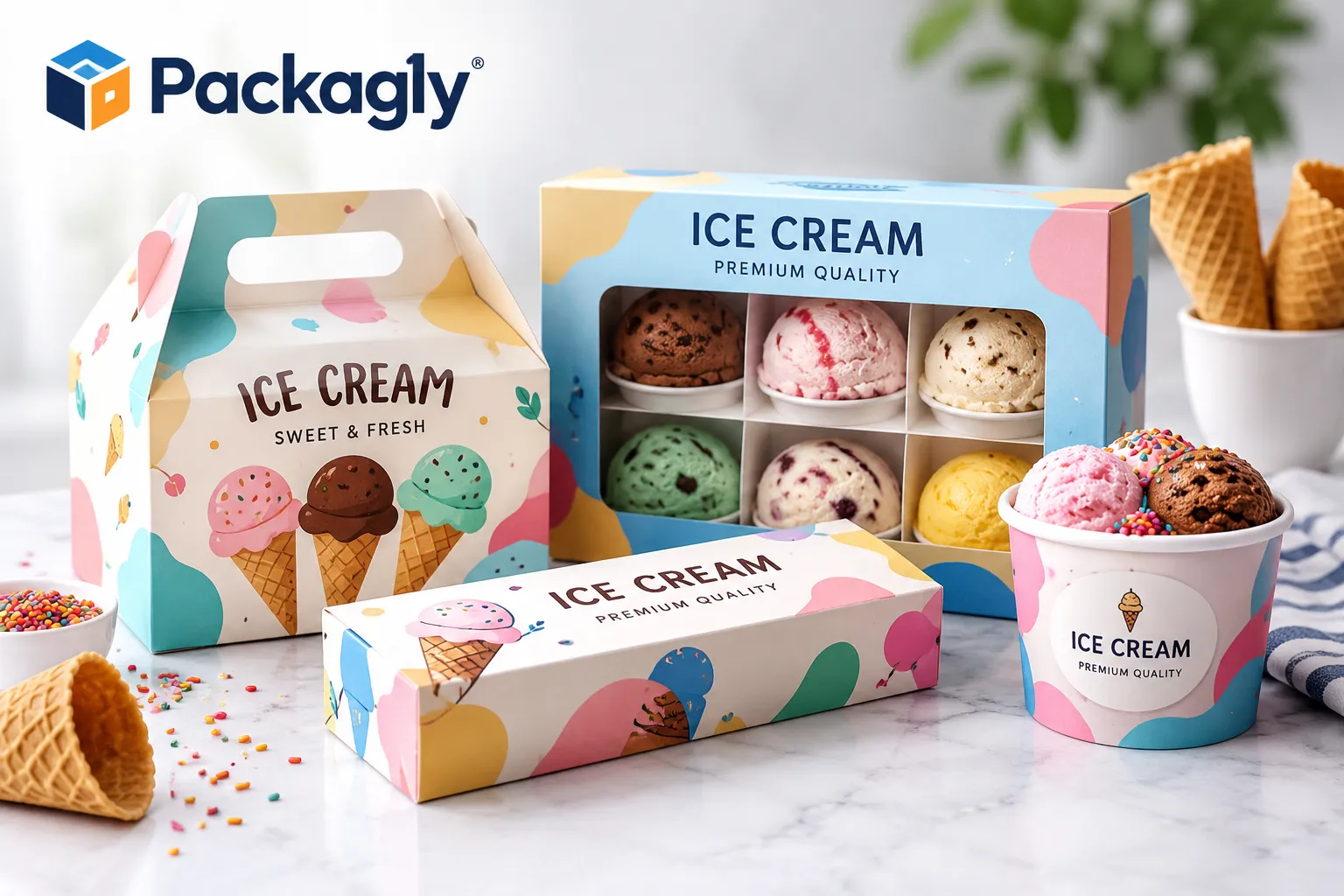
Custom ice cream boxes are cartons built to your size, print and structure. Makers use them for pints, ice cream sandwiches, cones, lollies and gift packs. Cafés and dessert shops use them for takeaway tubs and online orders.
Why do buyers pay so much attention to the box? Shoppers link good packaging with fresher, better-tasting food. A strong carton gives you room for flavour notes, allergen details and a short brand story.
Cold storage matters too. According to the USDA Food Safety and Inspection Service (2013), food kept at 0°F (-18°C) stays safe to eat. Your box has to cope with that temperature day after day without cracking, sweating or peeling.
Materials, styles and finishes for ice cream packaging
Most makers start with the board, because it sets both the cost and the performance. Coated paperboard is the usual choice for pint cartons. A thin food-grade barrier on the inside keeps moisture from soaking into the fibres.
Kraft board suits artisan brands that want a natural look. It needs a liner or coating to resist condensation. Corrugated board works for shipping boxes and multipacks, where strength matters more than fine print.
Style matters as much as material. Tuck-end cartons are simple and quick to fill. Window cartons let shoppers see the product, and sleeve designs slide over inner tubs for a premium feel. Pull-out drawers and sandwich sleeves suit single-serve treats.
Take a small-batch maker in Melbourne launching six flavours for summer markets. She chose coated paperboard pint cartons with a matt finish and a clear window. Condensation was her biggest worry, so she asked for freezer-tested samples before approving the full run.
A packaging engineer who works with UK dairy brands told us that most freezer failures come from the wrong coating, not the wrong board. That matches what we see. Test a carton in a real freezer for 48 hours before you order thousands.
Sustainability counts too. The American Forest & Paper Association (2021) reported that about 68% of paper in the US was recovered for recycling, so paperboard cartons fit well with existing recycling systems. Heavy plastic coatings can undermine that, so ask about water-based options.
The table below compares four common choices.
|
Material |
Best For |
Moisture Resistance |
Print Quality |
Recyclability |
|
Coated SBS paperboard |
Pint cartons and retail packs |
High with coating |
Excellent |
Widely recyclable |
|
Kraft paperboard |
Artisan and natural brands |
Medium, needs liner |
Good, earthy look |
Widely recyclable |
|
Corrugated E-flute |
Shipping boxes and multipacks |
Medium |
Good |
Widely recyclable |
|
Rigid box with insert |
Premium gift sets |
Low alone, needs inner pack |
Excellent |
Depends on laminates |
Production steps for custom printed boxes and what shapes the price
A good supplier walks you through the same path every time. Knowing it in advance helps you spot gaps in a quote.
How the process works
Here is how a typical order runs:
- Brief and dieline: you share product size, fill weight and quantity.
- Material and coating: the supplier recommends a board and a freezer-safe barrier.
- Artwork and digital proof: you approve colours, text and barcodes.
- Physical sample: you test it in a real freezer.
- Print and die-cut: the run is printed, cut, creased and glued.
- Packing and shipping: boxes travel flat to save space and freight cost.
Food rules apply at this stage. In the US, packaging that touches food must follow FDA food-contact rules. In the UK and EU, Regulation (EC) No 1935/2004 sets the same kind of standard. Canada, Australia and New Zealand have similar requirements, so ask for a declaration of compliance.
Labels carry rules too. UK makers follow the Food Information Regulations 2014 for allergen details, and US makers follow FDA allergen labelling law. Build that text into your artwork from the start.
What affects the cost
Custom ice cream boxes cost less per unit as your volume grows. Setup costs for the cutting die and printing plates spread across more boxes, so a bigger run lowers the price of each one.
Size, board thickness, the number of print colours, coating type, window film and finishes such as foil or spot gloss all change the quote. Inserts and dividers add more. Each extra feature should earn its place on the shelf.
As a rough guide, short runs of printed paperboard cartons often fall between $0.40 and $1.50 per box. Runs above 10,000 units can drop below $0.30. Prices vary by supplier, country and shipping route, so request itemised quotes.
Buyers in Ireland, South Africa or New Zealand should check freight too. Ask whether the quote includes shipping, import duties and VAT or GST.
How to choose a packaging supplier near you
Choosing a supplier feels easy until the first sample arrives soft and wet. What should you check before you commit? Start with certifications and freezer test results.
Ask for food-contact documentation and a recognised standard such as BRCGS Packaging Materials or FSC chain of custody. Ask about minimum order quantities, because some firms start at 5,000 units and others at 500. Check proof turnaround and lead times, which often run from 10 to 20 working days after approval.
Specialists handle frozen products better than general print shops. A supplier that focuses on food packaging, like Packagly, will usually keep freezer-tested board on hand, know the FDA and EU contact rules, and offer short runs for small brands. A general printer or national chain may not stock coatings built for sub-zero storage.
Do you want a partner who answers questions in plain language? Send each shortlisted supplier the same brief and compare the replies. The clearest, most detailed quote usually signals the smoothest project.
Frequently asked questions
How much do custom ice cream boxes cost in the UK?
Short runs of printed paperboard cartons typically cost between £0.35 and £1.20 each, depending on size, coating and print colours. Larger runs lower the unit price. Ask for itemised quotes that include shipping, VAT and any die or plate setup fees.
What is the minimum order for printed ice cream cartons in the USA?
Minimums vary widely. Digital printing suppliers may accept 500 to 1,000 units. Offset printers often start near 5,000. Lower quantities cost more per box, so small brands should compare digital and offset quotes side by side before choosing a supplier.
Are ice cream boxes freezer safe?
Yes, if the board has a food-grade moisture barrier. Uncoated paper absorbs condensation and turns soft within hours. Request freezer-tested samples and leave one in your own freezer for 48 hours before you approve a full order. Check the seams too.
Which materials suit ice cream packaging in hot climates like Australia?
Coated paperboard with a strong barrier layer copes best with heat and humidity. A thicker board holds its shape when cartons sit out of the freezer for a few minutes. Ask your supplier to test samples at the temperatures of your local summer markets.
Do ice cream boxes need food-safe certification in Canada?
Packaging that touches food must meet Health Canada requirements for food-contact materials. Coatings and inks deserve the closest attention. Ask your supplier for a declaration of compliance and keep it on file in case an inspector requests it.
What box size fits a standard pint of ice cream?
A US pint holds 473 ml, and many pint tubs measure roughly 4 inches across and 4.5 inches tall. UK and European tubs often hold 500 ml. Share your tub dimensions with the supplier, so the dieline fits with a small clearance.
Can I print my own design on ice cream boxes?
Yes. Most suppliers accept artwork in PDF or Adobe Illustrator files placed on their dieline template. Send vector files, keep text inside the safe area and check barcode size. You will receive a digital proof to approve before anything goes to print.
How long does production take?
Plan on 10 to 20 working days after proof approval for most printed paperboard cartons. Add shipping time, which can run from a few days within the UK to several weeks for sea freight to Australia or New Zealand. Order samples early to avoid delays.
Are paperboard ice cream boxes recyclable?
Most are, when the coating is water-based or a thin polymer layer that mills can separate. Heavy plastic laminates cause problems. Ask your supplier about recyclability claims, and check local rules in your area before you print a recycling symbol on the pack.
What adds the most cost to a printed ice cream carton?
Special finishes such as foil stamping, embossing and spot gloss raise the price quickly, as do window films and rigid inserts. Size and board thickness matter too. A clean design with two or three colours keeps costs low without hurting shelf appeal.
Your next step is simple. Write down your box size, quantity and finish, then order freezer-tested samples before you commit to a full run. Reach out to Packagly for a free quote and ask about coated paperboard options for your product. Compare the answer with one or two other suppliers and choose the one that explains costs clearly. A good box protects your flavours and helps your brand sell, so a little testing now saves money later