

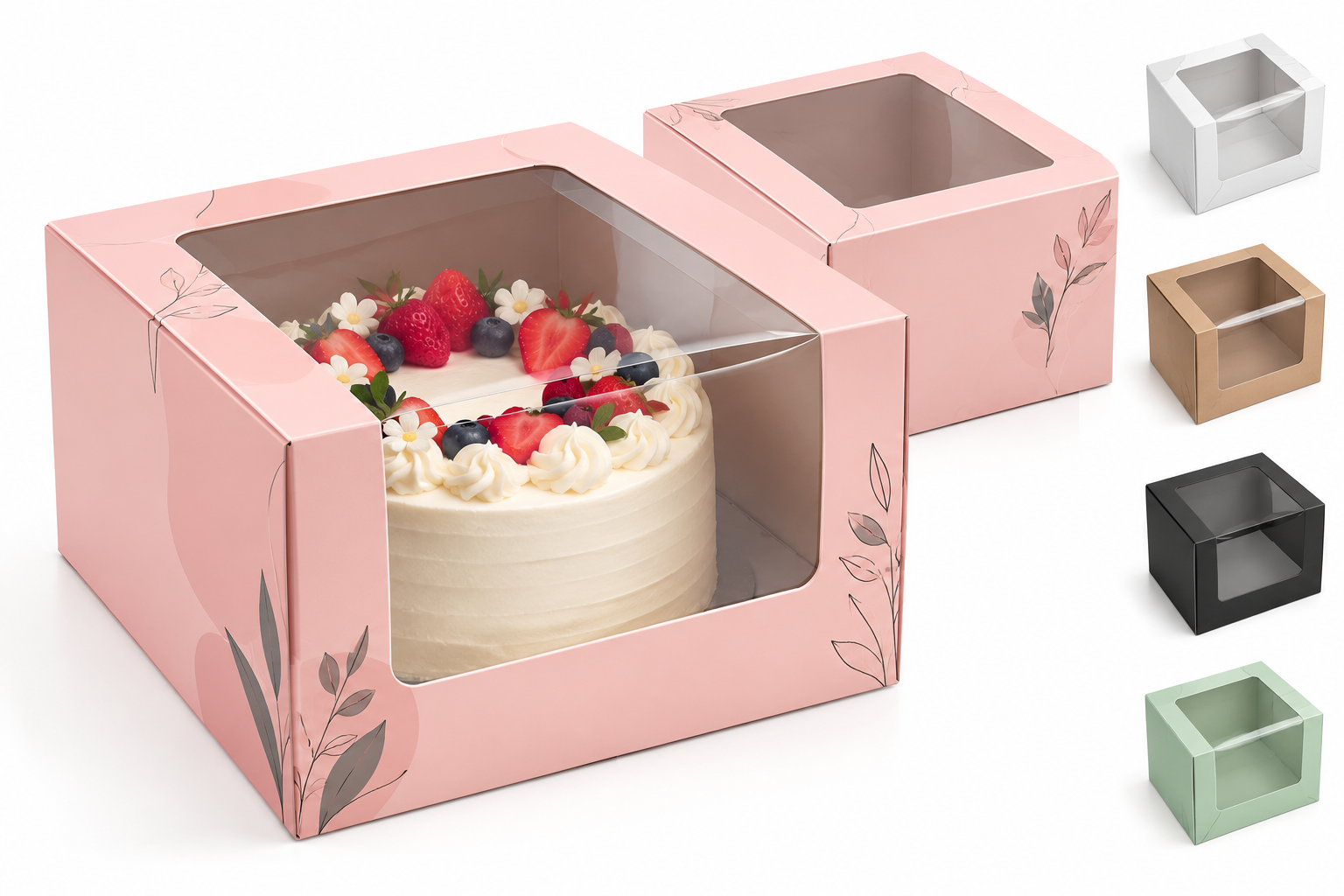
Packagly works with bakeries that share one puzzle. A cake looks stunning on the counter, then vanishes into a plain box before the customer leaves. Window cake boxes solve that. A clear panel shows the piping, the berries and the drip, so the cake keeps selling until the moment it changes hands. You now see them in high street bakeries, home kitchens and supermarket cafés from Dublin to Durban. Do you need a box for cupcakes, a tall celebration cake or a single slice? The answer depends on size, board strength, film type and budget. In this guide we cover materials, production steps, price drivers and the questions to put to a supplier. By the end, you will know what to order and what a fair quote looks like.
Why bakers pick a clear front panel
A cake sells on looks. Shoppers rarely open a box to check what sits inside, so a clear panel does that work for you. Many bakers find that a visible cake sparks more impulse buys at the till.
Protection matters just as much. A firm base, a fitted lid and sturdy walls stop frosting from sliding and sides from crushing. Cream-filled cakes also need to stay cold. The FDA Food Code (2022) sets 41°F (5°C) as the cold holding limit for perishable foods, so choose a box that fits your display fridge and travels well in a chilled bag.
Rules shape the design as well. In the UK, Natasha's Law has required full ingredient and allergen labels on food prepacked for direct sale since October 2021. That covers a cake sealed in a box at your own shop. Leave a clean panel or a sticker zone for that label.
Buyers watch waste too. According to the U.S. Environmental Protection Agency (2018), containers and packaging made up about 28 percent of municipal solid waste in the United States. A paper box with a small window uses far less plastic than a full dome lid.
Materials, sizes and closures compared
Four boards cover most bakery needs. White paperboard prints sharply and suits retail counters. Kraft board gives a warm, rustic look that fits artisan brands. Corrugated boards carry tall or heavy cakes and survive delivery vans. Rigid board makes gift cakes feel special, though it costs more and takes up space in storage.
The window itself needs a decision. Clear PET film is the usual pick because it stays crisp and resists moisture. Compostable PLA film suits eco-minded brands, but check its shelf life in warm kitchens. Grease matters too. Ask for a food-safe barrier coating, and request a food-contact declaration that matches your market, such as FDA rules in the US or Regulation (EC) No 1935/2004 in Europe.
Sizes follow the cake. Bakers commonly stock 6, 8, 10 and 12 inch square boxes, with a 4 inch height for sponge cakes and 5 to 6 inches for layered or domed bakes. Cupcake boxes use inserts that hold one, two, four, six or twelve. Lock-corner and pop-up styles fold fast, and magnetic lids work for premium gift orders.
|
Material |
Approx. unit cost (1,000 units) |
Strength |
Best for |
Recyclability |
|
White paperboard |
$0.35 to $0.90 |
Medium |
Retail counters |
Widely recyclable |
|
Kraft paperboard |
$0.30 to $0.80 |
Medium |
Artisan brands |
Widely recyclable |
|
Corrugated board |
$0.60 to $1.50 |
High |
Tall cakes, delivery |
Widely recyclable |
|
Rigid board |
$1.80 to $4.50 |
Very high |
Gift and wedding cakes |
Harder to recycle |
From sketch to bakery counter
Every supplier follows a similar path, and knowing it helps you spot gaps in a quote.
- You send the cake dimensions, height and any tier details.
- The supplier builds a dieline, which is a flat cutting template.
- Your designer adds artwork, logo and label space.
- You approve a digital proof and, ideally, a physical sample.
- The factory prints, die-cuts, applies the window film and glues the box.
- Boxes ship flat, ready to fold at your bakery.
Picture a home baker in Perth who launched a lemon drizzle loaf range. She ordered the first batch without a sample, and the window sat too low, hiding the top of the icing. A pastry chef in Manchester offers a rule most bakers learn late: cake boxes fail at the corners first, so ask for lock corners and test one with your heaviest bake. The Perth baker moved the window up two centimetres on her reprint and the problem disappeared.
What drives the price
Six things move a quote: order quantity, board weight, print colours, window size, finishes and freight. Setup costs for cutting dies and plates stay the same at 500 or 5,000 boxes, so unit prices fall quickly as volume rises. Digital printing suits small runs, while offset printing pays off past a few thousand units. Freight adds more for Australia, New Zealand and South Africa. Plain stock boxes cost only cents, but a custom printed run at 1,000 units usually lands between the ranges shown above.
Choosing a packaging partner
Start with proof of experience. Ask for sample boxes, board specifications, a written timeline and prices at three quantities. Bakery buyers notice weak glue lines and cloudy windows quickly, so inspect the samples by hand.
Specialisation counts. A supplier that focuses on food and bakery packaging, like Packagly, will already have dealt with grease-resistant coatings, food-contact declarations and dielines for tall cakes, which a general print shop often has not. That background shows up in fit, finish and fewer delays.
Next, ask about proofing and reprints. What happens if the window film arrives scratched? Who pays for a colour that prints darker than the proof? Clear answers before you pay save an argument later.
Check the storage advice as well. Boxes kept in a damp back room can warp before you use them, so ask how the supplier packs and protects cartons in transit.
Frequently asked questions
What are window cake boxes?
They are cake boxes with a clear film panel in the lid or side. The panel lets customers see the cake without opening the box. The rest of the box is a printed board, which protects the cake and carries your branding.
How much do window cake boxes cost?
Prices depend on size, board and print. At 1,000 units, paperboard styles often cost $0.35 to $0.90 each, and corrugated styles $0.60 to $1.50. Rigid gift boxes can pass $4. Setup fees for dies and plates add to the first order.
What is the minimum order for window cake box wholesale?
Many suppliers start at 500 to 1,000 boxes for custom prints. Stock sizes can go lower. Digital printing suits small bakeries testing a design. Ask for quotes at three quantities so you can compare the true cost per box.
Where can I buy custom window cake boxes in the UK?
Look for makers that print in the UK or Europe, since local production shortens lead times and avoids customs delays. Request sample boxes and a food-contact declaration before you order, and confirm the window film is food safe.
Do bakeries in Canada need bilingual cake box labels?
Most prepackaged foods sold in Canada need mandatory label text in both English and French, with some exemptions for foods prepared and sold at the same shop. Check current guidance from the Canadian Food Inspection Agency before you print.
Are window cake boxes food safe?
Yes, when the board, coating and film are made for food contact. Ask your supplier for a written declaration that meets FDA rules in the US or EU rules in Europe. Never place hot or greasy cakes in uncoated board.
Can a cake box with a clear window handle Australian summer heat?
Coated board and a snug lid cope well if the cake stays chilled. In Queensland or Western Australia, use an insulated bag for transport. Cold cakes can fog the window in warm air, so let them settle for a minute.
What size cake box do I need?
Choose a box about 1 to 2 inches wider than the cake board, and at least 1 inch taller than the decoration. Layered cakes with tall toppers often need a 6 inch height. Order one sample before you place a bulk run.
Are window cake boxes recyclable?
Most boards are recyclable in local paper streams. Some councils ask you to peel off the film, so use a small window and a film that peels cleanly. Compostable PLA film suits brands that want a lower plastic footprint.
How long does production take?
Standard runs take two to four weeks after proof approval, plus shipping. Sea freight to Australia, New Zealand or South Africa can add four to six weeks. Order early before wedding season, Mother's Day and the December rush.