

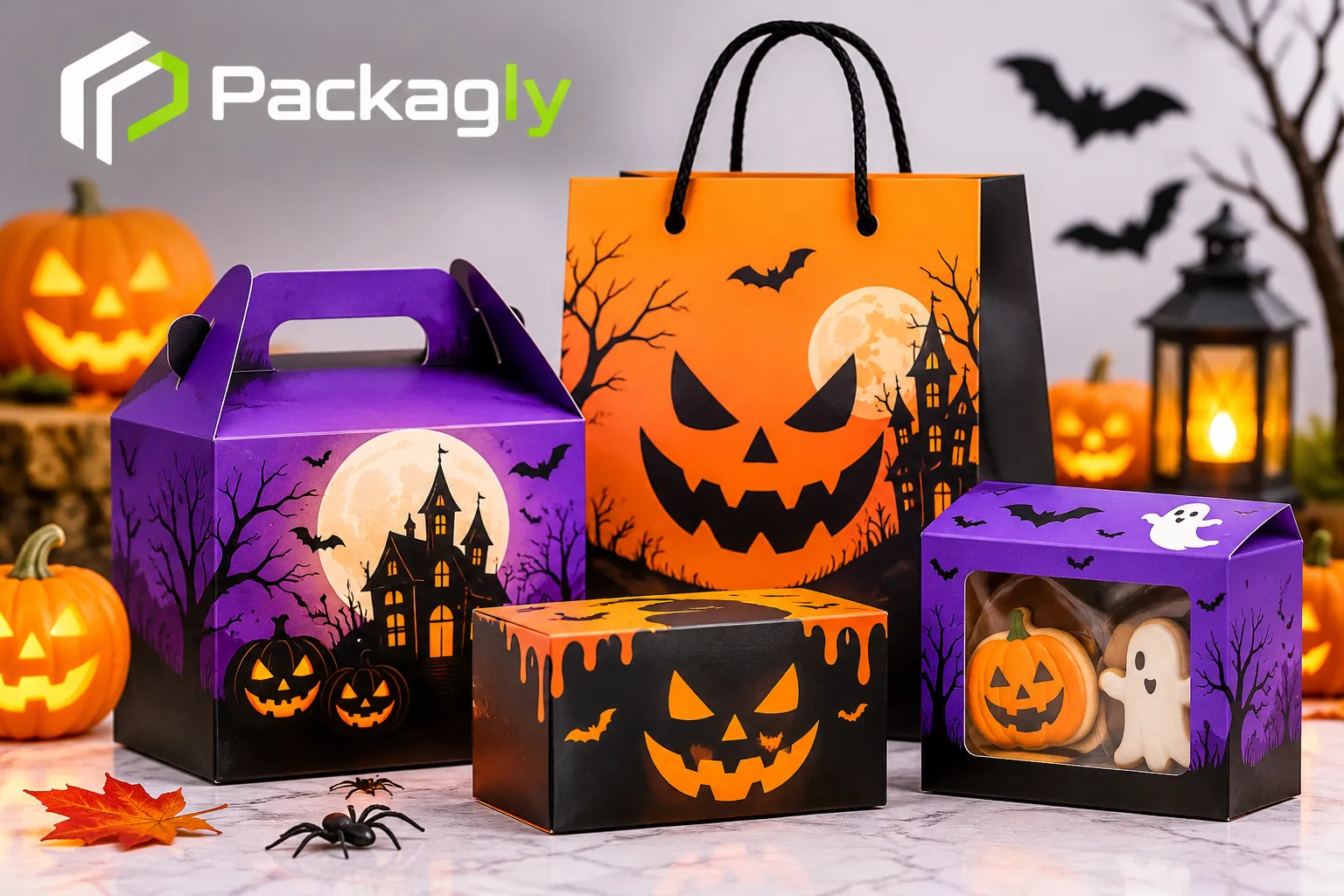
Every September, shoppers start hunting for orange, black and purple. Packaging makers such as Packagly see orders climb as small brands race to get ready. Why the rush? Because a plain brown box rarely gets a second look, and a spooky one gets photographed. Seasonal packaging has become part of the sale itself.
Custom Halloween boxes turn a routine parcel or treat pack into part of the holiday. They hold your candy, cookies, candles or gifts, and they tell shoppers your brand joined the fun. We wrote this guide for small business owners, bakers, retailers and online sellers who want clear answers before they order.
Here is what we cover. You will see which box styles work, how a print order runs, what drives the price and how to pick a supplier. Ten quick answers close the guide. Ready to start with the basics?
Why seasonal packaging earns attention in October
October has become one of the busiest months for treats and gifts. According to the National Retail Federation (2026), US shoppers plan to spend about $13.5 billion on Halloween this year. Candy leads the list, with 96% of consumers planning to buy sweets and $4.1 billion in expected spending.
That much candy needs a home, and a branded box gives it one. Shoppers want something they can hand over, post to a friend or photograph for social media. Packaging that looks seasonal does that job before anyone opens it.
Think about your own habits. You probably remember the ghost-window box or the bold black lid more than the plain mailer next to it. Custom Halloween boxes work the same way for your customers, and they keep working after the sale.
Buyers in the UK, Canada, Australia, New Zealand, Ireland and South Africa follow a similar pattern, though dates shift by market. Many retailers in Dublin or Auckland book print slots in July, since factories fill early.
Take a bakery in Leeds that sells a six-cookie Halloween set. The owner swaps plain white boxes for black ones with a gold bat print and a small window. Customers see the iced cookies at a glance, and the box looks good in photos.
Box styles, materials and finishes compared
What should your box do for you? Start with the product and the way it travels. A candy box on a shop counter needs good looks and food-safe stock. A cookie set posted across Canada needs strength first.
Kraft corrugated mailers handle shipping well and print cleanly in one or two colours. Folding cartons made from SBS paperboard are light and cheap, so they suit candy and small treats. Window boxes let shoppers see the product, which helps on a busy shelf. Rigid boxes feel premium but take up more storage space.
Match the box to the product. Shipped items need corrugated board. Shelf items do well in folding cartons, and gift sets suit rigid boxes.
Finishes change the look and the price. Matte lamination gives a soft, dark feel that suits the season. Spot UV adds shine to a pumpkin or a logo, and gold foil catches the light. For custom printed Halloween gift boxes, a matte rigid box with one foil detail often looks richer than full-colour print on thin board.
Climate matters too. Damp air in Ireland, the UK or coastal South Africa softens plain kraft, so laminated or varnished board lasts longer in storage. Many buyers now ask for FSC-certified paper, which shows the wood fibre comes from managed forests.
The table below shows typical ranges for 500 units in US dollars.
|
Box style |
Typical cost per box |
Durability |
Best for |
Watch out for |
|
Kraft corrugated mailer |
1.20–2.50 |
High |
Shipped cookie or gift sets |
Dark ink can look muted |
|
Folding carton (SBS paperboard) |
0.40–1.20 |
Medium |
Candy, chocolates, small treats |
Needs an outer carton to ship |
|
Rigid gift box |
2.50–6.00 |
High |
Premium sets, candles |
Takes up storage space |
|
Window candy box |
0.50–1.50 |
Medium |
Shop displays, cookies |
Film must be food-safe |
|
Sleeve and tray set |
1.00–3.00 |
Medium to high |
Multi-item treat packs |
Two parts to assemble |
How a printed box order works, step by step
A smooth order follows a clear path, and most delays come from skipped steps. Here is the usual sequence.
- Choose the box style, size and material for your product.
- Request a quote with quantity, print colours and finish.
- Receive a dieline, the flat template that shows folds and cut lines.
- Send your artwork and approve a digital proof.
- Approve a physical sample if you can, then start production.
- Check the first boxes on arrival before you pack.
Most custom runs take two to four weeks after proof approval, plus shipping time. A physical sample costs extra but can save a full reprint. One wrong colour across 1,000 boxes is a painful fix.
Artwork causes the most delays. Send a vector file with fonts outlined and a 3 mm bleed, and use CMYK colours. Dark Halloween palettes can print muddy on kraft, so ask for a colour swatch or a printed proof first.
Rules matter here too. In the United States, the FDA regulates food-contact materials under Title 21 of the Code of Federal Regulations. UK businesses above certain size limits must report the packaging they supply under Extended Producer Responsibility rules.
Do not print ink directly on a surface that touches food unless your supplier confirms the ink and coating are rated for food contact. A paper liner or wax sheet solves the problem in most cases.
Order 10% more than your forecast. A reorder in late October costs more and arrives late.
Cost factors and choosing a supplier
What moves the price per box
Quantity has the biggest effect on the price of custom Halloween boxes. Ordering 500 folding cartons might cost near $0.90 each, but 5,000 can bring that under $0.40.
Size, board thickness, print colours and finishes each add cost. A one-colour stamp on kraft costs far less than full-colour print with foil. A custom shape needs a cutting die, which adds a one-time tooling fee.
Freight, duties and tax raise the landed price, so ask for a delivered quote. Low minimums help small shops, and wholesale Halloween boxes with low minimums let a bakery order 250 units instead of 5,000.
Set a budget per box before you shop. If a $2 rigid box protects a $25 gift set, the cost is fair. If a $0.60 carton holds a $3 candy pack, keep it simple.
Design with reuse in mind. A black box with a small moon print can carry you through November. A bright pumpkin print sits unsold on 1 November.
How to choose a packaging partner
Price is only one factor. Ask each supplier for a sample, a proof timeline and a minimum order. Does the team answer your questions quickly? That tells you how they will handle a problem in week three.
Look at how much of a supplier’s work is custom packaging. Companies like Packagly that focus on printed boxes handle dielines, proofs and food-safe board every day. A general print shop or a national office-supply chain treats boxes as a sideline, so errors in fit or colour are more likely.
A packaging engineer in Ontario told us the most common error is a box that fits the product too tightly by a few millimetres. Ask for a test fit with your real items before you approve production. Check who owns the artwork files and whether proofs are included in the quote.
Frequently asked questions
What are custom Halloween boxes made from?
Most use kraft corrugated board, SBS paperboard or rigid greyboard wrapped in printed paper. Corrugated suits shipping, paperboard suits candy and small treats, and rigid board suits gift sets. Ask for FSC-certified stock if you want recyclable packaging. Your product and budget decide the choice.
How much do Halloween candy boxes cost in Canada?
Expect roughly CAD 0.60 to 1.70 per folding carton at 500 units, depending on size and print. Rigid boxes cost more. Add shipping, duties and sales tax, and ask for a delivered quote so the final total holds no surprises.
Where can I buy wholesale Halloween packaging in the UK?
Look for packaging manufacturers that print to order and ship to UK addresses. Compare quotes in pounds with delivery and VAT included. Ask about proofs, minimum order size and lead time before you pay, because peak season slots fill quickly from August.
Which Halloween packaging supplier in Australia ships to small businesses?
Many custom packaging makers ship to Australia, but terms differ. Check the minimum order, freight cost and customs fees before you commit. Halloween falls in spring there, so plan around local retail dates and allow extra weeks for sea freight.
How can I lower the cost per box?
Order larger runs, pick one or two print colours, and choose a standard size that avoids a custom die. A Kraft board with a simple stamp costs far less than full-colour foil. Reusing one design across the whole autumn spreads the cost.
Can I order a small batch of custom printed boxes?
Yes, many suppliers accept runs of 100 to 500 boxes, though unit prices run higher. Digital printing suits small batches because it skips costly plates. Ask each supplier for its minimum before you design, so your plan matches the order.
How long does a custom box order take?
Plan for two to four weeks after proof approval, plus shipping time. Rush options exist but cost more. Order by early August for a late-October launch, and allow extra time for samples and artwork fixes. Delays usually start with late artwork.
Do Halloween candy boxes need food-safe materials?
If candy touches the box, yes. In the United States, the FDA regulates food-contact materials under Title 21 of the Code of Federal Regulations, and UK rules are similar. Use a food-safe liner or approved coating, and ask your supplier to confirm in writing.
Will printed boxes hold up in damp weather in Ireland or the UK?
Corrugated board and paperboard soften in damp conditions. Store boxes in a dry room, off the floor. Rigid boxes with laminate resist humidity better than bare kraft. For long outdoor displays, ask about moisture-resistant coatings and varnishes.
What file format does a printer need for my artwork?
Most printers want a vector PDF or AI file with fonts outlined and a 3 mm bleed. Use CMYK colour, not RGB, and keep photos at 300 dpi. The supplier’s dieline shows exactly where folds and cuts sit.
Your next step is simple. Choose the product you want to sell, set a budget per box and fix your launch date. Order early, because print slots fill fast from August.
Collect two or three quotes and ask for a sample before you approve print. If you want help with sizes, materials or artwork, reach out to Packagly and talk through your options with the team. A clear brief and a little lead time keep the season calm. Good packaging should make your October easier