

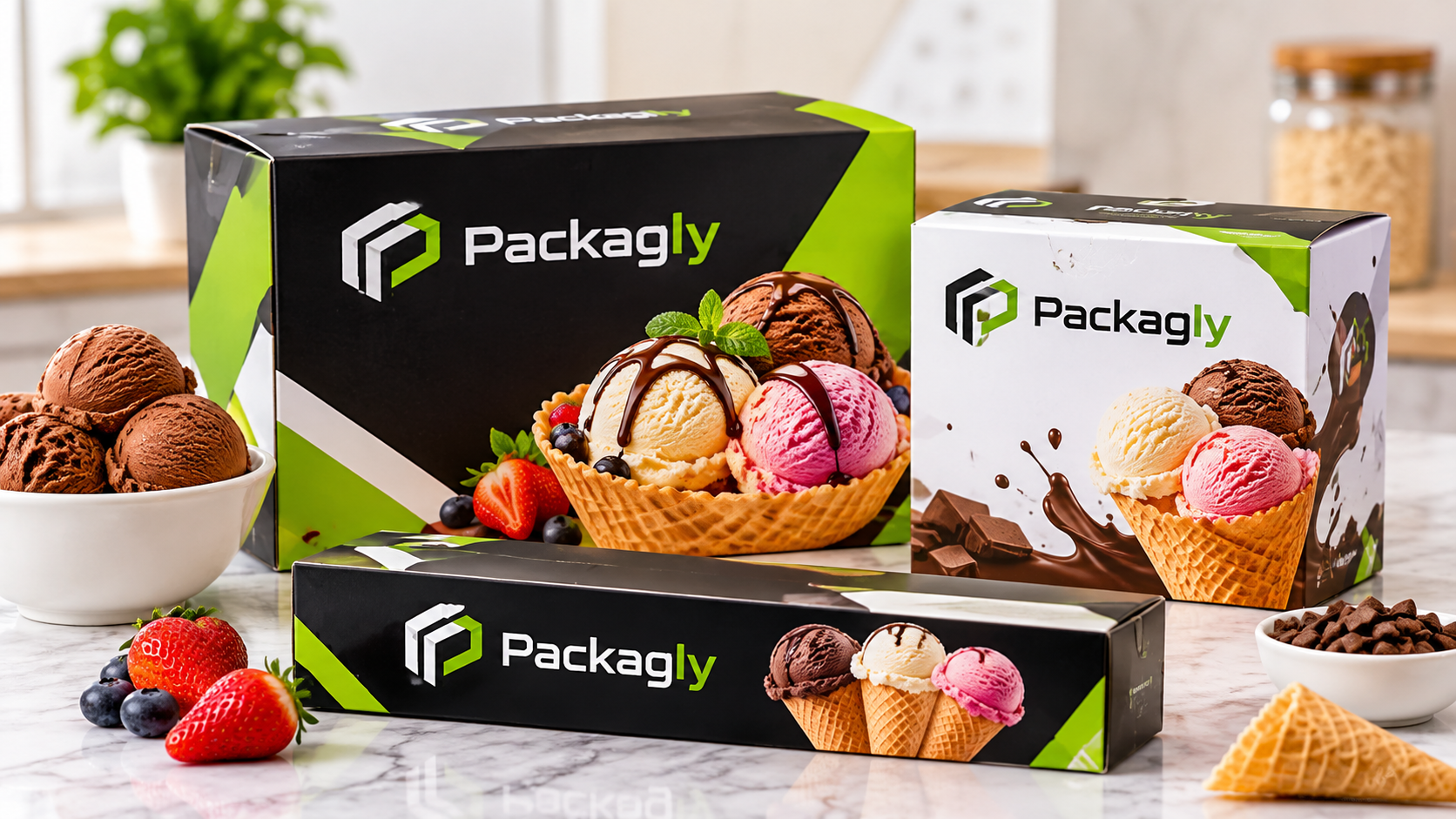
An ice cream product needs more than a good recipe to reach customers in perfect condition. Its packaging must protect the frozen dessert, support safe storage, and make the product easy to recognise. Packagly helps businesses source custom packaging that suits different frozen dessert products, sizes, and brand styles.
From single-serving ice cream bars to family-size tubs, each product has different packaging needs. A carton that works for a small retail tub may not suit a multipack or a delivery order. The material, coating, lid, seal, and print all affect how the package performs.
So, what should a food business look for before placing an order? The right choice starts with the product itself. You need to consider freezer conditions, moisture, handling, food-contact safety, storage, and the way customers open the pack.
Why frozen desserts need carefully planned packaging
Ice cream moves through several stages before it reaches a customer. It may be filled, hardened, stored, transported, displayed in a freezer, and carried home. Packaging must suit these conditions without losing its shape or making the product difficult to use.
A weak carton can absorb moisture and lose strength. A poor seal can let air reach the product. This may lead to freezer burn, unwanted odours, or changes in texture. A well-designed package helps reduce these risks when the product is handled and stored correctly.
The packaging format should match the product and sales channel. A small ice cream maker selling pints in local shops may need printed paperboard cartons. A manufacturer supplying supermarkets may need larger production runs, consistent dimensions, and packaging that works with filling equipment.
Delivery businesses face a different set of demands. Their products may need insulated shipping boxes, suitable liners, and a temperature-controlled delivery process. A printed retail carton alone cannot keep ice cream frozen during a long journey.
Brand presentation matters too. Customers often see the package before they taste the product. Clear flavour names, readable product details, and consistent colours help shoppers identify different varieties.
Research from Innova Market Insights, reported by Packaging Insights in 2023, found that ice cream and dessert product launches grew by an average of 2% per year between 2018 and 2022. Tubs accounted for 29% of the packaging formats tracked in 2022, and plastic represented 50% of the materials recorded. These figures show why brands need packaging that suits different product formats and buyer preferences.
Materials and formats for ice cream products
Choosing a material starts with the type of dessert, its storage conditions, and the way it will reach the customer. Each option has different strengths, costs, and design limits.
Coated paperboard cartons are common for ice cream pints and rectangular packs. They provide a broad print area for branding, ingredients, flavour details, and product information. A suitable barrier coating helps the board resist moisture during freezer storage. The coating and seams must match the intended use.
Plastic tubs and cups are useful for products that need a firm container and a fitted lid. Polypropylene is used in many food containers because it is lightweight and can be formed into different shapes. The exact grade must be suitable for its intended food-contact use and temperature conditions.
Flexible wrappers suit ice cream bars, sandwiches, and individual frozen treats. They can form a close seal around the product and use less storage space than rigid cartons. The film structure must suit the sealing process and protect the food during storage.
Corrugated outer cartons help group retail packs for transport and warehouse handling. They are not usually the direct container for loose ice cream. Their job is to protect the smaller packs during movement through the supply chain.
Molded fibre containers provide another option for brands looking to reduce conventional plastic use. Their moisture barrier, lid fit, strength, and freezer performance need testing before a large order.
The following table compares common options:
|
Packaging type |
Main benefit |
Main limitation |
Suitable use |
|
Coated paperboard |
Good print area |
Needs suitable barrier |
Pints and retail cartons |
|
Plastic tub |
Firm shape and fitted lid |
Material choice affects recycling |
Scoop ice cream and family tubs |
|
Flexible film |
Light and compact |
Needs correct sealing |
Bars and sandwiches |
|
Corrugated board |
Strong outer protection |
Not ideal for direct food contact without a suitable liner |
Multipacks and shipping |
|
Molded fibre |
Fibre-based appearance |
Barrier performance needs testing |
Selected tubs and lids |
A practical example can help. Imagine a small gelato brand launching four flavours in 500 ml tubs. It may choose a food-contact-approved tub with a secure lid, then use printed sleeves to show each flavour. This keeps the container format consistent and makes the range easier to recognise.
Custom Ice Cream Packaging Boxes should be tested with the actual product, not judged only by a flat sample. Check the fit, lid closure, print condition, moisture resistance, and handling after freezer storage. A sample test can reveal problems before the business commits to a large print run.
From artwork approval to freezer storage
A successful packaging order begins with accurate product details. The supplier needs to know the product dimensions, fill volume, storage conditions, and intended packaging format. Missing measurements can lead to cartons that fit poorly or lids that do not close as expected.
A typical process includes these stages:
- Define the product. Confirm whether the pack is for a pint, tub, bar, sandwich, multipack, or another frozen dessert. Record the product dimensions and fill quantity.
- Select the material. Choose paperboard, plastic, film, fibre, or an outer shipping carton based on the product's needs. Confirm that every food-contact component suits the intended use.
- Prepare the artwork. Add the logo, flavour name, ingredients, allergen details, net quantity, storage instructions, and other required information. Leave enough clear space for small print to remain readable.
- Review the dieline. Check folds, glue areas, seams, lid positions, and opening points. A digital proof helps identify layout problems before production.
- Test a sample. Place the sample in the intended freezer conditions. Check for changes in shape, coating, print, seal, and closure.
- Approve the production run. Confirm the final dimensions, material specification, print colours, quantity, delivery schedule, and agreed price.
Why test the package in a freezer? Room-temperature samples cannot show how a carton or seal will perform after exposure to cold and condensation. A practical test should reflect the real storage and handling conditions.
Food-contact safety needs attention at the material selection stage. The U.S. Food and Drug Administration explains that substances used in food packaging must have an appropriate regulatory basis for their intended use. This can include relevant food-contact regulations or an effective Food Contact Substance Notification.
The FDA's food-contact rules include 21 CFR Parts 174–178, which cover areas such as indirect food additives, adhesives, coatings, paper and paperboard components, polymers, and other substances. Ask the supplier for documentation that covers the exact material and intended conditions of use.
Product labels need careful review too. In the United States, the FDA requires packaged foods to identify the major food allergens used in the product. The nine major allergens include milk, eggs, fish, crustacean shellfish, tree nuts, peanuts, wheat, soybeans, and sesame. Ice cream brands should check ingredient and allergen information before approving final artwork.
What affects custom packaging costs?
Packaging costs depend on more than the size of the box. Material choice, printing, coating, order quantity, finishing, and production setup can change the final quote.
A basic printed carton may cost less than a pack with foil details, a special shape, or a complex barrier structure. A small order may have a higher unit price because setup costs are spread across fewer pieces.
Packagly lists Ice Cream Packaging Boxes at a displayed starting price of $0.13 per unit on its product page. This is a listed starting figure, not a guaranteed price for every size, order quantity, or specification. Request a current quotation based on the exact design and material.
Key cost factors include:
- Order quantity: Larger runs can reduce the cost per unit by spreading setup expenses.
- Board or film specification: Material grade, thickness, and barrier features affect the price.
- Printing method: Digital and offset printing have different setup costs and production limits.
- Finishing: Lamination, foil, embossing, and spot effects add production steps.
- Box structure: Custom dimensions, inserts, windows, and special closures can increase tooling costs.
- Shipping and storage: Freight, duties, and warehouse space can affect the total order cost.
Ask suppliers to separate setup charges, unit prices, shipping, and any extra finishing fees. Compare quotations with the same dimensions and material specifications. A lower unit price may not be a better deal if the carton needs a different coating or fails a freezer test.
How to choose a packaging supplier
A supplier should understand the demands of frozen food packaging, not just the printing process. Ask about material specifications, food-contact documentation, sample production, quality checks, and delivery planning.
Check whether the supplier can produce the format your product needs. Some businesses require simple pint cartons. Others need printed sleeves, multipack boxes, custom tubs, or shipping cartons. A supplier with suitable production options can help keep the packaging consistent across a product range.
Charles Golub, Marketing Manager for Food and Beverage at ProAmpac, discussed the need to match packaging with flavour protection and consumer experience in a 2023 interview with Packaging Insights. His comments reflect a key point for frozen dessert brands: the package must protect the product and work for the person buying it.
Before approving an order, ask these questions:
- Can you provide material specifications for the intended freezer conditions?
- Is the food-contact material suitable for the product and its storage use?
- Can I review a physical sample before full production?
- What quality checks take place during printing and finishing?
- Can the design work across different flavours and sizes?
- What are the production and delivery times?
Packagly provides custom packaging options for businesses that need different sizes, print choices, and finishing details. Compare the available specifications with your product requirements before placing an order. A clear brief helps the supplier recommend a suitable structure and prepare a more accurate quote.
Frequently asked questions
What are ice cream packaging boxes made from?
They can use coated paperboard, kraft board with a suitable food-contact liner, plastic, or flexible film. The right material depends on the product, freezer conditions, moisture exposure, and packaging format. Ask for documentation that confirms suitability for the intended use.
Which packaging is best for ice cream pints?
Coated paperboard cartons and suitable plastic tubs are common choices. Paperboard gives brands a broad print area, whereas a plastic tub provides a firm container with a fitted lid. Test the closure and freezer performance before choosing.
How much do custom ice cream packaging boxes cost?
Packagly displays a starting price of $0.13 per unit on its product page. Your actual price depends on dimensions, material, quantity, printing, coating, and finishing. Request a quote based on your final design.
Can printed cartons withstand freezer storage?
They can, if the board, coating, seams, and inks suit the intended conditions. Standard uncoated paperboard may absorb moisture and lose strength. Ask for a sample and test it in your normal freezer conditions.
Are paper ice cream containers recyclable?
Some paper-based containers can be recycled, but the result depends on coatings, liners, food residue, and local recycling rules. Check the full material structure with the supplier and confirm acceptance with your local recycling service.
What information should appear on ice cream packaging?
Requirements vary by country. Common details include the product name, ingredients, allergen information, net quantity, business details, and storage instructions. Check the rules in each market where the product will be sold before approving the artwork.
Can I order custom ice cream boxes in small quantities?
Some suppliers support short runs, but minimum quantities depend on the printing method, material, and box structure. Digital printing may suit a small launch run. Ask about sample orders and minimum quantities before preparing the artwork.
What packaging works for ice cream delivery?
Home delivery may need an insulated shipping system, suitable liners, and a validated temperature-control plan. A printed retail carton alone does not keep ice cream frozen during transit. Test the complete shipping setup before sending customer orders.
Are plastic tubs safe for frozen desserts?
A plastic tub can be suitable when its material and additives meet the rules for the intended food-contact use. Ask for the supplier's compliance documents and confirm that the container is suitable for the product and storage conditions.
How can I keep ice cream packaging consistent across flavours?
Use a shared carton structure, print layout, logo position, and information hierarchy. Change the flavour name and approved colour details for each variety. This gives the product range a clear family look without confusing one flavour with another.
Take the next step with your ice cream packaging
The right package protects your product, supports clear labelling, and gives customers a good experience from freezer to table. Start by confirming your product size, storage needs, material requirements, and sales channel. Then request samples and compare full quotations before approving production. If you are planning a new range or updating an existing design, contact Packagly to discuss suitable sizes, print options, and finishing choices. A clear packaging brief can help you make a sound choice for your next order