

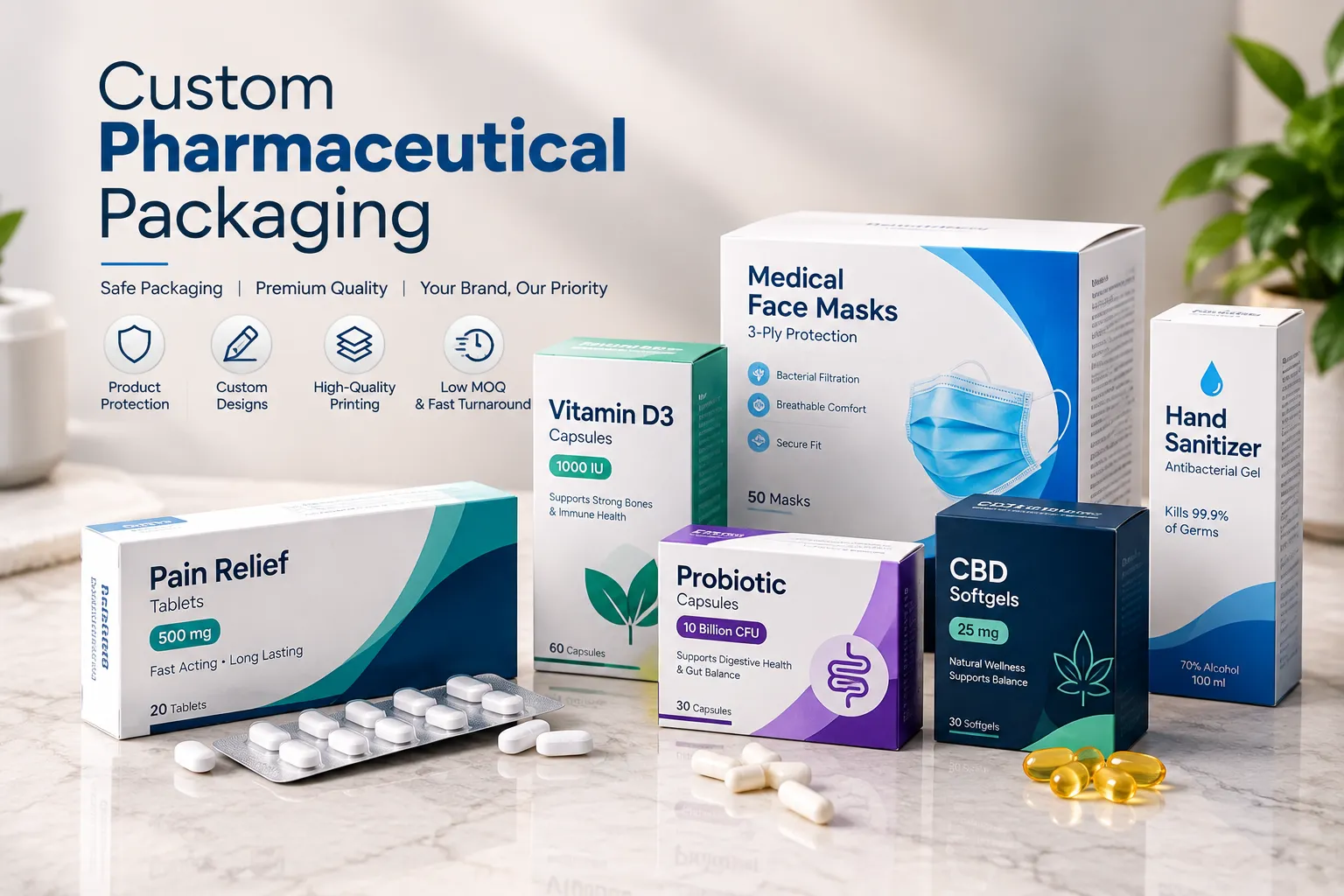
A pill bottle does more work than most people realize. It protects the dose inside, proves the product is real, and carries your brand name onto a pharmacy shelf or a patient's kitchen counter. Custom pharmaceutical packaging pulls all three jobs into one design, and getting it wrong carries real risk.
At Packagly, we work with pharmaceutical brands that need packaging built for compliance first and brand recognition second. The stakes are not small. According to the World Health Organization (2017), an estimated 1 in 10 medical products circulating in low- and middle-income countries is either substandard or falsified, a figure that makes tamper-evident and traceable packaging a safety issue, not a design preference. This guide covers material options, the development process, real cost ranges, and how to pick a packaging partner who understands the compliance side of the job.
What custom pharmaceutical packaging is and why brands invest in it
Pharmaceutical packaging covers more ground than most consumer packaging categories. It has to protect the drug from moisture and light, prove it has not been opened, and carry dosage information a patient can read without confusion.
Demand for better packaging keeps climbing alongside counterfeiting concerns. Research from ResearchAndMarkets (2024) projects the global pharmaceutical packaging market will reach $176.54 billion by 2031, growing at a 7.6% annual rate, with counterfeit protection and tighter regulation named as key drivers behind that growth.
Brands invest in custom pharmaceutical packaging for a few clear reasons: child-resistant closures reduce liability, tamper-evident seals protect brand trust, and consistent branding across a product line builds pharmacy and patient recognition over time.
Pharmaceutical packaging material options compared
Material choice affects barrier protection, cost, and how well the packaging holds up during shipping and storage. Glass still leads for sterile injectables, while HDPE plastic dominates solid oral dose bottles.
|
Packaging Type |
Avg. Cost (per 1,000 units) |
Barrier Protection |
Best For |
Compliance Features |
|
Glass Vials |
$800–$1,500 |
High (moisture, light) |
Injectables, sterile liquids |
Tamper-evident caps |
|
HDPE Bottles |
$300–$600 |
Moderate–High |
Tablets, capsules |
Child-resistant closures |
|
Blister Packs (PVC/Alu) |
$400–$900 |
High (unit-dose) |
Tablets, softgels |
Unit-dose serialization |
|
Paperboard Cartons |
$150–$350 |
Low (secondary use) |
Outer packaging, inserts |
Track-and-trace codes |
A packaging compliance specialist working with mid-size pharmaceutical brands in New Jersey told us that most clients underestimate how much serialization equipment adds to setup cost. Track-and-trace codes on cartons now sit at the center of most regulatory requirements, and retrofitting a packaging line for this feature costs far more than building it in from the start.
How custom pharmaceutical packaging gets developed
A packaging project starts with a review of the drug's stability needs, since light sensitivity, moisture exposure, and temperature range all shape material choice before design work begins. This step also confirms which regulatory pathway applies to your product and market.
Once the material is set, a structural design phase maps out the container shape, closure type, and label placement. You review physical prototypes and run stability testing to confirm the packaging protects the product through its full shelf life.
After testing passes, the project moves into production tooling and serialization setup. Final runs go through quality checks for seal integrity, label accuracy, and batch coding before shipping to your fill-and-finish partner.
What affects custom pharmaceutical packaging costs
Material choice drives a large share of the total price. Glass vials cost more per unit than HDPE bottles, largely because of higher shipping weight and breakage risk during transport.
Order volume changes the per-unit math in a big way. A run of 5,000 units costs more per piece than a run of 50,000, since tooling and setup costs spread across more units at scale.
A few other factors shape your final packaging cost:
- Serialization and track-and-trace coding required under regulations such as the US Drug Supply Chain Security Act
- Child-resistant closure testing, which adds both material and certification cost
- Custom print runs for branding, versus stock packaging with a printed label
- Cold-chain requirements for temperature-sensitive biologics
How to choose the right pharmaceutical packaging partner
A general packaging supplier can print a label and ship a box, but pharmaceutical packaging carries compliance requirements that a generalist rarely tracks in full. Companies like Packagly that focus on custom pharmaceutical packaging understand serialization rules, child-resistant testing standards, and the material barrier data regulators expect to see in a submission file.
Before you commit to a supplier, ask whether they run stability testing in-house or outsource it, confirm their experience with your specific dosage form, and check that their facility holds current Good Manufacturing Practice (cGMP) certification.
Frequently Asked Questions
What regulations apply to custom pharmaceutical packaging in the US?
The Drug Supply Chain Security Act requires serialized, traceable packaging for most prescription drugs sold in the US. Packaging must also meet Poison Prevention Packaging Act rules for child-resistant closures where applicable.
Do UK pharmaceutical packaging rules differ from the US?
Yes, UK and EU markets follow the Falsified Medicines Directive, which requires a unique identifier and tamper-evident feature on most prescription packaging, separate from the US serialization system.
How much does custom pharmaceutical packaging cost for a small production run?
A small run of 5,000 HDPE bottles typically costs between $1,500 and $3,000, including standard child-resistant closures. Glass vial runs of the same size cost more due to material and shipping weight.
What drives the price difference between glass and plastic pharmaceutical packaging?
Glass costs more to produce, ship, and handle due to breakage risk, while HDPE plastic offers a lighter, cheaper option with slightly lower barrier protection against light and oxygen.
Where can I find pharmaceutical packaging suppliers in Canada?
Look for a Canada-based supplier registered with Health Canada's packaging and labeling requirements. Confirm they can meet bilingual labeling rules required for products sold across Canadian provinces.
Does custom pharmaceutical packaging hold up in hot or humid climates?
HDPE bottles and glass vials both resist humidity well when sealed correctly, though blister packs need a moisture barrier layer for markets with high humidity, such as parts of the southern US or Southeast Asia.
What is child-resistant packaging and when is it required?
Child-resistant packaging uses a closure design that children under five struggle to open, and it is required for most oral prescription drugs sold in the US, UK, and Canada under national poison prevention rules.
How long does it take to develop new pharmaceutical packaging?
A full development cycle, from material selection through stability testing and production tooling, usually takes 3 to 6 months, depending on dosage form and whether new tooling is required.
What is serialization in pharmaceutical packaging?
Serialization assigns a unique code to each package unit, allowing regulators and supply chain partners to trace the product from manufacturing through to the pharmacy shelf.
Can custom pharmaceutical packaging include brand-specific printing?
Yes, most suppliers offer custom printing on cartons, labels, and some bottle types, though tamper-evident and compliance features still take priority over branding elements in the design.
What certifications should a pharmaceutical packaging supplier hold?
Look for current Good Manufacturing Practice (cGMP) certification and ISO 15378 compliance, which confirms the supplier follows quality standards specific to primary pharmaceutical packaging materials.
How do I know which packaging material fits my drug product?
Stability testing data determines this, based on how the drug reacts to light, moisture, and oxygen exposure over its shelf life. A packaging partner should run or review this testing before recommending a material.
Ready to plan your packaging project?
Custom pharmaceutical packaging works best when compliance requirements, material choice, and branding get mapped out together from the start, rather than added on after testing begins. Once you know your dosage form and target market's regulations, the material and cost decisions follow naturally. If you want help comparing material options or working through serialization requirements for your next production run, reach out to Packagly for a quote based on your product and volume needs