

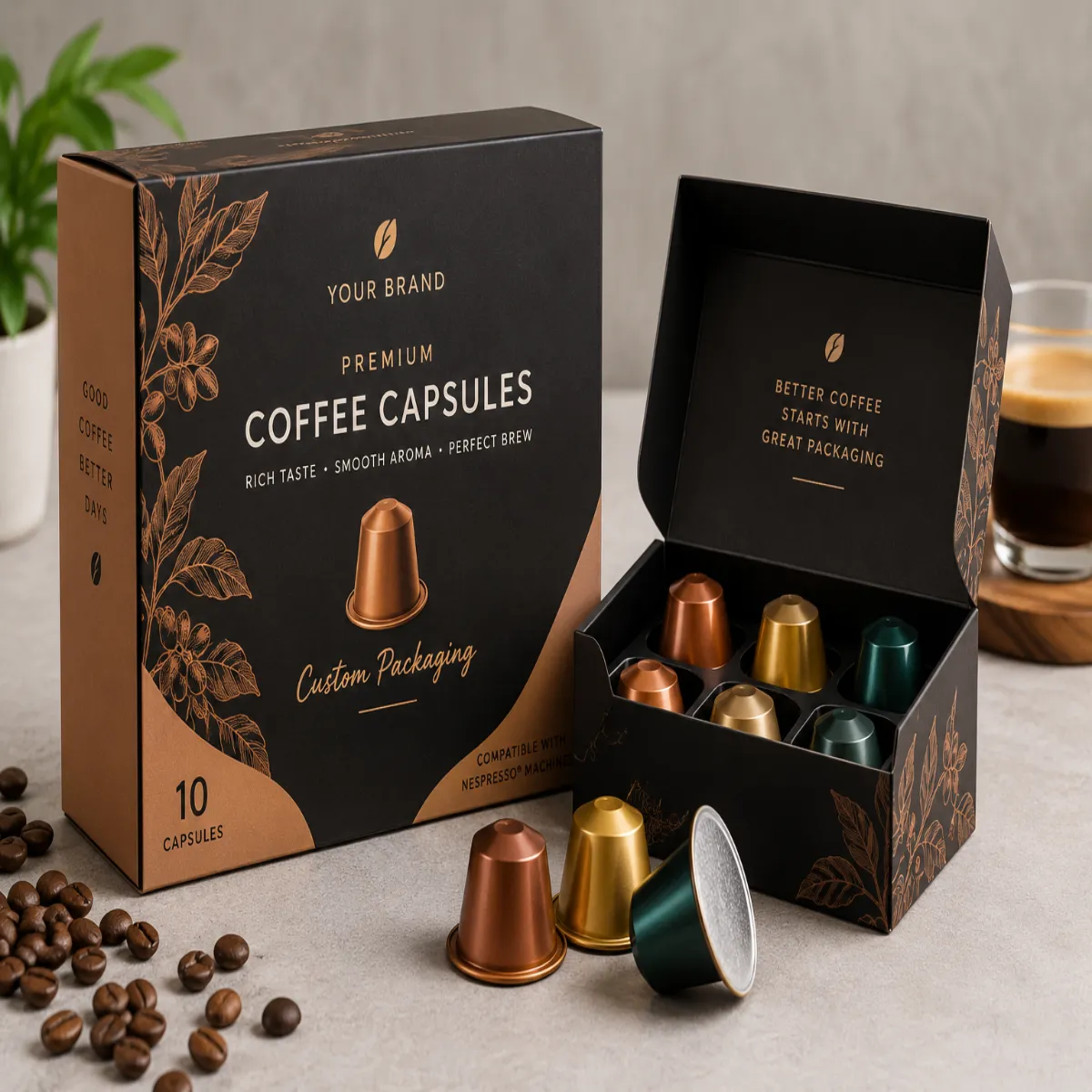
Coffee pods sell on more than what's inside them. A roaster can source the best beans in the country, but if the box on the shelf looks generic, buyers scroll past it. Custom coffee capsule packaging gives small and mid-sized coffee brands a way to compete with the big names without a big-name budget. The right box protects freshness, tells your story in five seconds flat, and gives a customer a reason to pick your capsules over the one next to them.
This guide walks through the materials, design choices, and cost factors that go into custom coffee capsule packaging, plus the steps a packaging provider takes to turn your artwork into a finished box. You'll get a clear comparison of common box types and a straight answer on what things cost, so you can plan your next production run with fewer surprises.
Why Coffee Roasters Choose Custom Capsule Packaging
Coffee capsules face a tougher shelf test than most food products. Light, air, and moisture all work against roasted coffee, and a pod's tiny format leaves little room for error in the box design. A poorly sealed or under-protected capsule box can let coffee go stale weeks before the "best by" date.
Branding matters just as much as protection here. According to a 2022 study published by the Paperboard Packaging Council, shoppers form a purchase opinion about a packaged food product within roughly seven seconds of seeing it on a shelf. For a coffee brand competing against dozens of similar-looking pods, that seven-second window is the whole sales pitch. Custom coffee capsule boxes let a brand use color, finish, and structure to stand out in that window rather than blend in.
There's a practical side too. Custom sizing means fewer wasted inches of shelf space and lower shipping costs, since boxes built to fit ten or twenty capsules exactly don't waste cardboard or cubic volume the way generic stock boxes do.
Materials and Box Types: What Fits Your Brand
Not every coffee brand needs the same box. A specialty roaster selling small-batch pods through a subscription service has different needs than a wholesale brand stocking supermarket shelves. Here's what typically separates the common options.
Kraft paperboard is the go-to for brands leaning into a natural or sustainable image. It's sturdy enough to hold ten to twenty capsules, takes print well, and can be sourced from FSC-certified suppliers. Rigid boxes cost more but suit premium or gift-set coffee lines, since the thicker walls give a heavier, higher-end feel in hand. Corrugated mailer boxes work best for direct-to-consumer brands shipping capsules straight to a customer's door, as the extra layer absorbs bumps during transit. Compostable or recyclable mono-material boxes have gained ground with brands that want their packaging to match compostable capsule pods, closing the loop between product and box.
Printing finish plays into brand perception almost as much as the box material. Matte lamination gives a soft, understated look that suits organic and single-origin coffee lines, while gloss or soft-touch coatings add shine that draws the eye on a crowded shelf. Foil stamping or embossing on the logo works well for premium tiers but adds cost, so it's usually reserved for flagship products rather than a full catalog.
|
Box Type |
Avg. Cost (per 100 units) |
Best For |
Maintenance/Handling |
|
Kraft paperboard |
$80–$150 |
Everyday, natural-branded pods |
Store in dry conditions |
|
Rigid box |
$250–$450 |
Gift sets, premium single-origin lines |
Low; sturdy by design |
|
Corrugated mailer |
$100–$180 |
Direct-to-consumer shipping |
Handles transit well |
|
Compostable mono-material |
$150–$280 |
Eco-focused brands, subscription boxes |
Keep sealed until use |
The Process: From Artwork to Finished Box
Getting from a logo file to a stack of finished coffee capsule boxes follows a fairly consistent path, whether you're ordering 500 units or 50,000.
It starts with a design consultation, where the packaging provider reviews your capsule count per box, target market, and any regulatory labeling you need (nutrition panels, allergen statements, or roast date fields, for example). From there, a structural die-line is built to match your exact capsule dimensions, since a box that's even a few millimeters off can leave pods rattling around during shipping.
Once the structure is locked, the provider produces a digital or physical proof so you can check colors, text, and barcode placement before a full run goes to press. Printing typically uses offset or digital methods depending on order volume, digital being more cost-effective for smaller runs under a few thousand units. After printing, the boxes are die-cut, folded, and glued, then packed flat or assembled depending on how your fulfillment team wants to receive them.
A specialist we spoke with, a packaging consultant with over a decade in the coffee and beverage sector, put it this way: "Most delays in coffee packaging come down to die-line mismatches caught too late. Getting a physical sample before the full print run saves roasters real money and real time." That single step, an in-hand sample, catches problems a screen proof never will.
Cost Factors for Coffee Capsule Packaging
Price on a run of custom coffee capsule boxes swings on a handful of variables, and knowing them ahead of time makes budgeting easier.
Order volume drives the biggest swing, since setup costs for die-cutting and plate-making get spread across more units on a larger run. A run of 500 boxes might land at 80 cents per unit, while 10,000 units of the same design can drop below 20 cents each. Material choice matters next: rigid boxes and compostable mono-materials cost more per unit than standard kraft stock. Finish options like foil stamping, embossing, or spot UV each add incremental cost, typically 5 to 15 percent over a base print job. Shipping and lead time also factor in, since rush production usually carries a premium of 10 to 20 percent over standard four-to-six-week turnaround.
One realistic scenario: a small-batch roaster launching a twelve-count capsule line for farmers' markets and a handful of local cafes might order 1,000 kraft boxes with single-color print, landing in the range of $300 to $500 total. A wholesale brand pushing into grocery chains with a 24-count box, full-color print, and a gloss finish could see costs closer to $1,200 to $2,000 for a 5,000-unit run.
How to Choose the Right Packaging Provider
Picking a provider for custom coffee capsule packaging comes down to a few concrete checks rather than gut feel.
Ask to see food-grade material certifications, since coffee capsule boxes often sit directly against product or a compostable pod liner and need to meet food-contact safety standards. Check minimum order quantities against your actual production volume, because a provider built for 50,000-unit runs may charge a steep premium on a 500-unit order. Look at turnaround time commitments in writing, not just verbally, and ask what happens if a print run misses a deadline.
What separates a packaging specialist from a general print shop or a national chain? A provider that works specifically with food and beverage packaging will have already solved problems specific to coffee, like moisture-resistant coatings and capsule-tight die-lines, rather than treating your order like any other box job. Companies like Packagly that focus on custom packaging across food and beverage categories tend to have those die-line templates and material sourcing relationships already in place, which shortens the back-and-forth on a first order.
Getting a written quote that breaks out material, print, and finishing costs separately makes it easier to compare providers apples to apples, rather than comparing two lump-sum numbers that hide different assumptions.
Frequently Asked Questions
What is custom coffee capsule packaging?
It refers to boxes and outer packaging designed specifically for coffee pods or capsules, built to a brand's exact capsule count, dimensions, and artwork rather than a generic stock box.
How much does custom coffee capsule packaging cost?
Pricing typically ranges from $80 to $450 per 100 units depending on material, print complexity, and finish, with larger orders lowering the per-unit price.
What's the minimum order for custom coffee pod boxes?
Minimums vary by provider, with some accepting orders as small as 250 to 500 units and others requiring 5,000 or more for custom print runs.
Are compostable coffee capsule boxes worth the extra cost?
For brands selling compostable pods, a compostable box completes the sustainability story and can support premium pricing, though it typically costs 20 to 40 percent more than standard kraft.
Do coffee capsule boxes need food-safe certification?
Yes, especially when the box material contacts the capsule directly. Look for FDA-compliant or food-grade certified stock from your packaging provider.
What printing method works best for small coffee capsule runs?
Digital printing suits run under a few thousand units since it avoids the plate setup costs of offset printing, keeping smaller orders affordable.
How long does it take to produce custom coffee capsule packaging?
Standard production runs four to six weeks from approved proof to delivery, with rush options available for an added cost.
Can coffee capsule boxes include nutrition or allergen labeling?
Yes, and most providers build these fields into the die-line during the design phase so labeling stays compliant with local food packaging regulations.
What box material holds up best for shipped coffee capsules?
Corrugated mailer boxes handle transit best, since the extra layer cushions capsules against impact during shipping.
Do I need a permit to sell packaged coffee capsules?
Requirements vary, but most regions require compliance with food labeling regulations covering ingredients, roast date, and net weight on the outer packaging.
How many capsules typically fit in a standard custom box?
Ten, twelve, and twenty-four count boxes are the most common formats, though custom die-lines can accommodate any count a brand needs.
What's the difference between rigid and kraft coffee capsule boxes?
Rigid boxes use thicker board for a premium, sturdy feel suited to gift sets, while kraft boxes are lighter, more cost-effective, and better suited to everyday product lines.
Getting Your Packaging Right
Choosing custom coffee capsule packaging comes down to matching the box to your product, your customer, and your budget, in that order. A specialty roaster selling twelve-count gift boxes has different priorities than a wholesale brand shipping pallets to grocery chains, and the right provider will walk through those differences with you rather than push a one-size-fits-all box. If you're weighing material options or need a sample before committing to a full run, reach out to Packagly for a quote and a look at what fits your capsule line.