

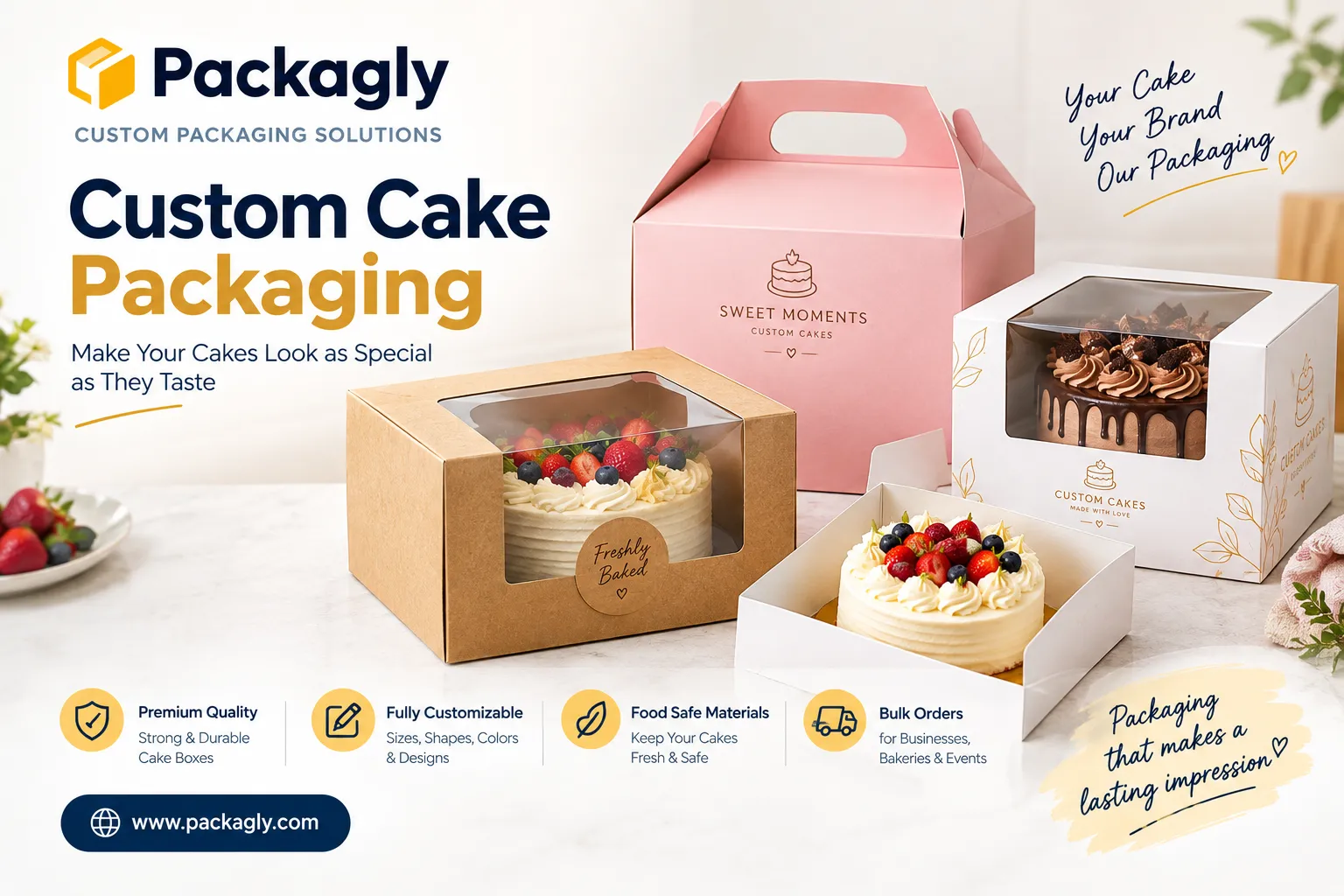
A great cake can arrive looking tired. Icing smears, a lid dents, and the customer remembers the box more than the bake. Packagly supplies packaging to bakers, and the pattern is clear: the right box protects your work and sells your brand at the same time.
So how do you choose custom cake packaging without wasting money on the wrong size, board, or finish? This guide walks you through box styles, materials, ordering steps, costs, and supplier checks. It works for home bakers in Manchester, café owners in Toronto, and dessert shops in Melbourne.
Why the right box matters for your cake business
Think about the last cake you bought online. Did the box feel sturdy when it landed? That first touch tells buyers how much care went into the cake.
Packaging shapes buying choices too. An Ipsos study for the Paper and Packaging Board found that 72 percent of American consumers say package design influences what they buy. For a cake business, that means your box works like a silent salesperson on the counter, on the doorstep, and in every photo a customer posts.
Custom cake packaging also solves practical problems. A box cut to your cake size stops sliding. A grease-resistant liner keeps buttercream off the board. A printed logo turns each delivery into free advertising.
Take a baker in Cardiff who ships layered sponges across Wales. Her first plain boxes arrived crushed twice in one month. She switched to a corrugated box with a die-cut insert and a one-colour logo, and the damage complaints stopped.
Box styles and materials worth comparing
Your cake, your delivery route, and your budget decide the best style. Four options cover most bakeries.
Kraft paperboard boxes look natural and suit eco-minded brands. They handle single-tier cakes well, and they take one-colour print cleanly. Heavy fondant cakes may need a stronger board.
White paperboard (SBS) gives the sharpest print. Bright colours and photos show at their best on white. It costs a little more than kraft and shows fingerprints if uncoated.
Corrugated E-flute boxes suit shipping. The fluted layer absorbs bumps, so cakes survive courier handling. They add weight and cost, and print detail is softer.
Rigid gift boxes suit wedding favours and premium mini cakes. They feel luxurious and hold their shape for years. They cost the most and take up more storage room.
|
Option |
Avg. cost per box |
Strength |
Best for |
Trade-off |
|
Kraft paperboard |
0.60–1.80 |
Medium |
Local pickup, eco brands |
Muted print colours |
|
White paperboard (SBS) |
0.70–2.20 |
Medium |
Bright branding |
Shows scuffs |
|
Corrugated E-flute |
1.00–3.00 |
High |
Courier delivery |
Softer print |
|
Rigid gift box |
3.00–8.00 |
Very high |
Favours, luxury minis |
Highest price |
Prices show typical rates for runs of 500 to 1,000 units and change by size, print, and finish.
From measuring to delivery: how a custom order works
A clear process saves time and cuts errors. Most orders follow six steps.
- Measure the cake width, height, and cake board thickness.
- Choose a style and material.
- Request quotes and a sample kit.
- Send artwork on the supplier's die-line.
- Approve a digital or printed proof.
- Test a real cake before the full run.
Size deserves extra care. An 8-inch cake usually needs a box around 10 by 10 by 5 inches, and a 6-inch cake fits an 8 by 8 by 5 box. Leave 1 to 2 cm of clearance so the icing never touches the lid.
A packaging engineer in Ontario often tells bakers to test boxes with a drop and vibration check, similar to the ISTA transit tests couriers use. Even a simple version helps: pack a real cake, drive it around town, and inspect it. Suppliers like Packagly that make custom bakery boxes for wholesale buyers can guide you on inserts, board weight, and food-safe liners before you commit.
Lead times run about 8 to 15 business days after proof approval. Foil, embossing, and overseas freight add days, so order well ahead of wedding season and holidays.
What you pay for: pricing, minimums, and hidden fees
How much should you budget for custom cake packaging? The answer depends on six things.
- Quantity: 1,000 boxes can cost half as much per unit as 250.
- Board: heavier or corrugated board adds cost.
- Print: one-colour logos cost less than full-colour CMYK.
- Finish: matte lamination, foil, and spot UV each add a fee.
- Inserts: cake boards, dividers, and windows raise the unit price.
- Shipping: freight, duty, and import tax add up on overseas orders.
A one-colour kraft box in a 1,000-unit run often lands between $0.60 and $1.80. Small runs of 100 to 250 boxes can cost $2 to $5 each. Ask for a quote that lists tooling, proofs, and delivery, since some suppliers add die charges late.
Small-batch buyers should ask about digital printing. It removes plate costs and suits runs from 100 boxes. You pay more per box, but you avoid storing 2,000 boxes in a flat.
Sustainability affects price and appeal. According to the American Forest & Paper Association (2022), corrugated recovery in the United States runs above 90 percent. Recyclable paperboard boxes fit local kerbside schemes, and eco-friendly cake boxes appeal to buyers who care about waste.
How to pick a supplier you can rely on
What separates a good supplier from an average one? Start with food safety. In the United States, paper and paperboard for food contact fall under FDA rules in 21 CFR Part 176. The UK and EU follow Regulation (EC) No 1935/2004, and Canada applies its Food and Drugs Act. Ask every supplier for a food-contact declaration covering the board, liner, and any window film.
Next, check samples. Order a sample kit, then pack a cake, chill it, and carry it for an hour. Look for warping, grease marks, and weak corners.
A specialist that makes bakery boxes every week, like Packagly, will know grease-resistant liners, cake-size die-lines, and insert options. A general print shop or office chain may quote a low price but miss details, such as a lid that bows under a heavy fondant cake. Specialists also tend to offer low minimums and design help, which matters for small bakeries.
Finally, read the fine print. Ask who pays if boxes arrive crushed and how long a reprint takes. A supplier who answers quickly now will treat your reorders the same way.
Frequently asked questions
How do I choose custom cake packaging for my bakery?
Start with your cake size and delivery method. Pickup orders suit kraft or white paperboard. Courier orders need corrugated board with inserts. Then check food-safety papers, order a sample kit, and test with a real cake before placing a full run.
How much do custom cake boxes cost?
A printed paperboard box costs about $0.60 to $2.20 in runs of 1,000. Small runs of 100 to 250 can reach $2 to $5 per box. Board weight, print colours, finishes, and freight change the final quote.
What is the minimum order for custom cake boxes?
Minimums range from 100 to 1,000 boxes depending on the supplier. Digital printing supports small runs, while offset printing suits larger ones. Ask for a price break table so you can see how the unit cost falls as quantity rises.
Are custom cake boxes food safe in the UK?
Yes, when the board and coatings meet UK and EU food contact rules under Regulation (EC) No 1935/2004. Ask your supplier for a declaration of compliance and keep it on file. Local authority inspectors may ask to see it.
What food-safety rules apply to cake packaging in the United States?
Paper and paperboard for food contact fall under FDA rules, including 21 CFR Part 176. Coatings and films need their own clearance. Ask your supplier for written confirmation, and check state rules if you sell across state lines.
Can I order wholesale cake boxes in Australia or Canada?
Yes. Many suppliers ship to Australia and Canada, and digital printing supports runs from 100 boxes. Ask about freight time, duty, and taxes before you pay. Sea freight can take two to four weeks, so plan ahead.
Do cake boxes hold up in hot or humid weather?
Standard paperboard can soften in high humidity, and grease can seep through thin boards. Choose a coated or grease-resistant liner for summer. Bakers in warm places like Queensland or Texas often pick heavier boards and keep boxes in a dry store.
What size box do I need for a tiered cake?
Measure the total height with the cake board, then add 2 to 3 cm. A two-tier cake often needs a box 12 inches wide and 10 to 12 inches tall. Tall boxes with side-loading or lift-off lids protect the top tier.
Are eco-friendly cake boxes as strong as standard ones?
Yes, when made from kraft or recycled board at the right weight. A 350 gsm kraft board holds a single-tier cake well. Heavier cakes may need corrugated boards. Ask for a sample and test it with your recipe.
How long does custom packaging take to arrive?
Production takes about 8 to 15 business days after proof approval. Shipping adds a few days locally or several weeks overseas. Foil, embossing, and special coatings can add more time, so order six to eight weeks before busy seasons