

Packagly works with CBD brands every week, and the same question comes up almost every time: which box actually fits a small-batch tincture line or a growing edibles brand? The answer depends on your product, your budget, and how your customer first sees the box on a shelf or in a mailer. This guide breaks down the materials, the printing choices, and the cost factors so you can pick packaging that protects your product and represents your brand well.
CBD boxes are not just containers. They carry compliance labeling, they protect sensitive formulas from light and moisture, and they set the tone before a customer even opens the product. Get the wrong box and you risk damaged inventory, unclear dosage information, or a package that looks cheap next to a competitor's shelf display. Get the right one and your packaging becomes part of your marketing.
What CBD boxes actually need to do
A CBD box has three jobs: protect the product, communicate required information, and support the brand. Many CBD formulas are light-sensitive and oxidize faster when exposed to UV, so a box with a light-blocking coating matters more here than in most consumer packaging categories.
Regulatory labeling adds another layer. Most CBD products need visible batch numbers, milligram counts, QR codes linking to lab reports, and warning statements. A box that's too small to carry this information clearly will cause problems at retail or with a marketplace listing. Buyers who ask why their tincture boxes look cluttered usually find the answer is simple: the box was sized for the bottle, not for the label requirements.
Why does this matter so much for a small or mid-size brand? Because a returned shipment or a rejected retail order over a labeling issue costs far more than the box itself.
Comparing CBD box materials
Different materials suit different product types, price points, and shipping needs. Here's how the common options stack up.
|
Material |
Avg. Cost (per 500 units) |
Durability |
Best For |
Custom Printing |
|
Kraft cardboard |
$280–$420 |
Moderate |
Tinctures, capsules, eco-focused brands |
Good, earthy finish |
|
Rigid cardstock |
$650–$950 |
High |
Premium gift sets, vape kits |
Excellent, high-end look |
|
Corrugated (E-flute) |
$310–$480 |
High, shipping-safe |
Edibles, bundles, subscription boxes |
Good |
|
SBS (solid bleached sulfate) board |
$400–$600 |
Moderate to high |
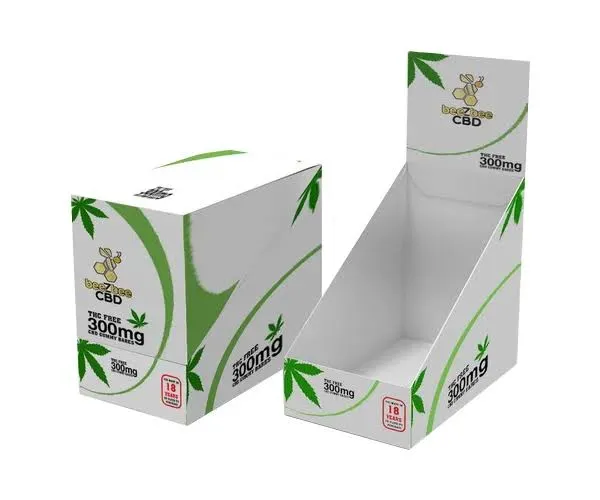
Retail shelf boxes, cosmetics-style CBD lines |
Excellent, sharp color |
Kraft board suits brands that want a natural, apothecary look and lower unit cost, though it takes ink differently than coated stock, so expect slightly muted colors. Rigid boxes cost more but hold their shape through repeated handling, which matters for gift bundles that get opened and closed several times. Corrugated stock is the safest pick if your product ships directly to the consumer, since it absorbs impact during transit far better than thin cardstock.
The SBS board sits in the middle: it prints sharp colors and fine text, which helps when a label needs a small font for dosage details, but it needs a protective coating for anything shipping long distances.
The process from order to delivery
Ordering CBD boxes usually follows a predictable sequence, and knowing the steps helps you plan your launch timeline.
First, you send product dimensions and any label requirements so the die line can be built. Second, a proof comes back, usually a flat digital mockup followed by a physical sample for anything over a few thousand units. Third, once the proof is approved, the print run starts, which typically takes 7 to 12 business days depending on finish and quantity. Fourth, boxes ship flat or assembled, based on your storage space and whether you have staff to fold them.
A packaging brand called Packagly, working with CBD sellers across the US, structures this timeline around compliance review as a built-in step, checking that batch codes and warning text are legible before the run goes to print rather than after. Skipping that check is one of the most common reasons brands end up reprinting an entire order.
What drives the cost of CBD boxes
Several factors push the price up or down, and understanding them helps you budget accurately.
Print complexity matters most. A single-color kraft box with basic text costs far less than a four-color box with foil stamping or spot UV coating. According to the Printing Industries of America (2023), custom finishing techniques like foil and embossing can add 20 to 35 percent to base unit costs, which explains why premium CBD lines often price their packaging separately from standard runs.
Order quantity is the second driver. Unit price drops sharply between 250 and 1,000 units, then levels off. A brand ordering 5,000 boxes might pay 40 percent less per unit than one ordering 250, since setup costs get spread across more pieces.
Box structure also plays a role. A simple tuck-end box costs less to produce than a two-piece rigid box with magnetic closure. Child-resistant features, increasingly required for edibles in several states, add both material and testing costs.
Lastly, shipping and storage costs depend on whether boxes arrive flat-packed or pre-assembled. Flat-packed saves freight costs but requires labor on your end to fold and load.
How to choose the right CBD box supplier
A good supplier does more than print a box. They understand the compliance side of CBD packaging, they catch labeling errors before print, and they can advise on material choices based on how your product actually performs over time.
Ask a potential supplier how they handle proof revisions, what their minimum order quantity is, and whether they've printed for CBD or hemp-derived products before. A supplier without that experience may not flag issues like ink bleed on required warning text, which can create compliance headaches later.
Companies like Packagly that work specifically with CBD and hemp brands tend to have a practical edge over general packaging vendors. They've already handled the label placement questions, the material testing for light-sensitive formulas, and the small-batch runs that many general print shops treat as an afterthought. A general commercial printer might offer a lower base price, but they often lack the trade-specific insurance and compliance familiarity that CBD-focused suppliers carry as standard practice.
Picture two brands ordering the same tincture box. One works with a general printer and discovers after delivery that the QR code placement blocks the required warning label. The other works with a CBD-focused supplier who flagged that exact layout issue during the proof stage. The second brand launches on schedule. The first reprints an entire batch.
Frequently asked questions
What size CBD box do I need for a standard 30ml tincture bottle?
Most 30ml tincture boxes measure around 1.5 by 1.5 by 4.5 inches, though the exact size depends on whether you're including an insert card or extra padding. Always confirm dimensions with a physical sample before ordering in bulk.
How much do custom CBD boxes cost for a small first order?
A first order of 250 to 500 kraft boxes typically runs between $280 and $420, depending on print complexity. Rigid or foil-finished boxes cost more, often starting near $650 for the same quantity.
Do CBD boxes need to be child-resistant?
Several states require child-resistant packaging for CBD edibles specifically, so check your state's regulations before finalizing box structure. Tinctures and capsules usually fall under different rules than gummies or infused foods.
What information is legally required on a CBD box label?
Requirements vary by state and product type, but most labels need milligram content, batch number, a QR code or link to a lab report, and a standard warning statement. A packaging supplier familiar with CBD compliance can help confirm what applies to your product.
How long does it take to receive a custom CBD box order?
Standard turnaround runs 7 to 12 business days after proof approval, though rush production is often available for an added fee. Larger orders with complex finishes may take closer to 3 weeks.
Can I order a small batch of CBD boxes before committing to a large run?
Most suppliers offer sample runs of 50 to 250 units so you can test the fit, print quality, and shelf appeal before placing a bulk order. This is worth the extra cost for a first-time product launch.
Which material holds up best for CBD products shipped directly to customers?
Corrugated E-flute board handles shipping impact better than standard cardstock, making it a common choice for subscription boxes and direct-to-consumer edibles. It also protects against minor moisture exposure during transit.
Do CBD boxes protect the product from light degradation?
Some CBD formulas break down faster under UV exposure, so a box with a matte or UV-coated finish adds a layer of protection beyond what the bottle alone provides. This matters most for oil-based tinctures.
How do I compare pricing between different CBD box suppliers?
Compare cost per unit at the same quantity and finish level, since a lower quote sometimes reflects lower minimum print runs or thinner board stock. Ask each supplier for a like-for-like quote on identical specifications.
Are foil stamping and spot UV worth the extra cost for CBD packaging?
These finishes can raise perceived value on retail shelves, which matters for premium or gift-oriented CBD lines. For subscription or bulk-sale products, a simpler finish often makes more financial sense.
What's the difference between flat-packed and pre-assembled CBD boxes?
Flat-packed boxes cost less to ship and store but require staff time to fold before use. Pre-assembled boxes cost more upfront but save labor, which suits brands without dedicated packing staff.
Can CBD box suppliers help with compliance-related label placement?
A supplier experienced with CBD products can flag layout issues, such as a QR code or seal covering required warning text, before the print run starts. This kind of review can prevent a costly reprint.
A simple next step
Choosing a CBD box comes down to matching material, size, and finish to how your product actually gets used and shipped. Start with your compliance requirements, then work backward to a material and structure that fits your budget and order volume. If you want a supplier who already understands the label rules and material needs specific to CBD products, Packagly offers sample runs and can walk through material options for your product line without any pressure to commit right away